
It took me a while to figure out what to write for my first blog post—something I’ve wanted to start for years, rather than simply sharing random thoughts on social media. There’s a saying that our destiny is shaped by our deepest intentions and desires. The Upanishads express this beautifully: “You are what your deepest desire is. As your desire is, so is your intention. As your intention is, so is your will. As your will is, so is your deed. As your deed is, so is your destiny.”
So here I am—finally drafting posts, reflecting on ideas. Yet despite having everything ready for over a week, I haven’t managed to finish a single one.
What often comes to mind are the days I spent in Central Asia, especially the long road trips. Travel, as they say, broadens the mind. As the road stretches ahead, the landscape continuously changes, and each moment becomes fleeting—like a memory fading in the rearview mirror. You see tree branches swaying in the wind, leaves tumbling through the air, and before you know it, these moments vanish forever.
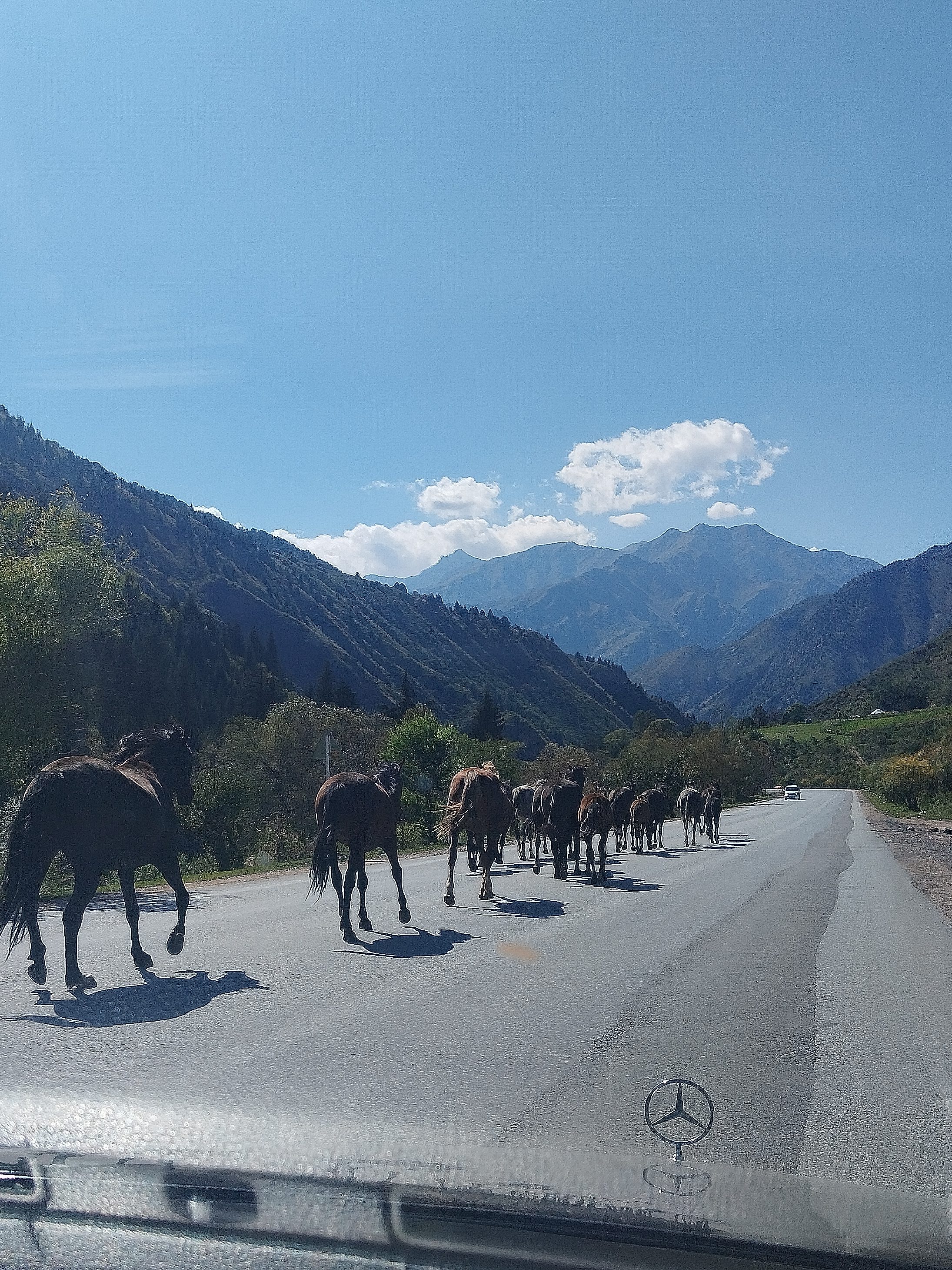
One of the most unforgettable experiences during the trip was the day-long drive from Bishkek, Kyrgyzstan, to Osh, a border city near Uzbekistan. After about two hours, the scenery transformed into vast mountain valleys and green steppes, dotted with herds of cattle and wild horses. At times, horses galloped alongside the car. In those moments, life felt the most vivid.
The human mind is like a feather in the wind, constantly influenced by the external world. Socrates once said, “Know thyself.” But can we truly understand ourselves? Is it even possible to know ourselves without engaging with the world around us? Much of what we discover about who we are arises through our interactions with others. Through these engagements, we encounter perspectives—some uplifting, others critical—that shape our understanding of ourselves.
In Critique of Pure Reason, Immanuel Kant argues that we can never know things as they are in themselves (noumena), but only as they appear to us through our senses and mental faculties. Our strengths and weaknesses reveal themselves when we face challenges that disrupt our mental models. Our perception of ourselves and our reactions are deeply intertwined with the world around us. Achieving self-awareness in isolation seems almost mythical; true self-understanding emerges when we reflect on how we respond to the people and situations in our environment.
Yet, this raises another dilemma: how can we be sure that our reactions are the “right” ones? Could different reactions have led to completely different outcomes? The balance between subjective and objective reality plays a major role here. As Khalil Gibran wrote in The Prophet, “Say not, ‘I have found THE truth,’ but rather, ‘I have found A truth.’” Even that “truth” can be interpreted in entirely different ways. An ultra-fundamentalist and an ultra-liberal are two sides of the same coin, each believing they serve a higher truth.
Philosophical views often shape how we define these realities. Upon reflection, we realize that we are constantly guided by a personal philosophy—whether we’re conscious of it or not. This philosophical framework influences everything—our spiritual growth, our approach to relationships, and even our material pursuits.
Three of the most prominent philosophical frameworks in modern society are Liberalism, conservatism, and socialism. They have shaped political, social, and economic arenas for centuries, each offering distinct perspectives on governance, individual rights, and economic systems. Liberalism promotes open markets, individual freedoms, and innovation, while conservatism emphasizes the preservation of cultural and religious norms. Socialism, meanwhile, seeks economic equity through collective ownership and redistribution of resources.
I recently encountered an argument about how these philosophies impact human development, particularly material progress. The question of “how much progress is enough” within the context of Ottoman conservatism in late 90s, for instance, offers deep reflections on the tension between tradition and modernization. For Ottoman conservatives, this question was tied to the preservation of religious identity, traditional governance, and societal values.
At its height, the Ottoman Empire was on par with Western nations in technology, infrastructure, and the arts. Conservatism, with its focus on preserving established values, resisted modernization, fearing the erosion of these cultural and religious pillars. On the other hand, liberal economies fostered rapid technological and material progress.
Russian philosopher Alexander Dugin argues that liberalism, in its pursuit of ultimate freedom, seeks to liberate humanity from human identity itself, highlighting the ideological conflict between East and West. As technological and scientific advancements in fields like AI and biotechnology accelerate, Dugin warns that liberalism risks undermining essential elements of human existence, such as family, community, and national identity. Conservative critics, particularly in Eastern societies, believe that by pushing boundaries too far, liberalism erodes what makes us human.
During my travels in Central Asia, I observed that traditional lifestyles, practiced for millennia, continue to thrive. People remain deeply rooted in values like hospitality, community, and empathy—qualities that modern progress often overlooks. I’ve come to appreciate the debate over “how much progress is enough” and recognize that there’s no singular answer to this question. Each society, shaped by its unique history and values, strikes its own balance between tradition and modernization.
Ultimately, the journey toward self-understanding is shaped by the philosophies we adopt. Just as travel broadens the mind, engaging with different ideas helps us better understand ourselves and the world around us. Perhaps self-awareness isn’t about finding one “truth” but about embracing the complexity of the many truths we encounter along the way.
 faznotes.com
Leave a comment