
Jordan’s Foreign Minister, Ayman Safadi, criticized Israel in September 2024 for its lack of a clear “end game” in its strategy, accusing the nation of perpetuating conflict rather than pursuing resolution. Responding to Israeli Prime Minister Benjamin Netanyahu’s assertion that “we are surrounded by enemies,” Safadi emphasized, “We are here, members of the Muslim-Arab committee, mandated by 57 countries. I can tell you unequivocally that all of us are willing, right now, to guarantee Israel’s security, provided that Israel ends the occupation and allows for the emergence of an independent Palestinian state.”
His remarks underscore a pervasive misunderstanding within the Arab world regarding Zionism’s strategy. Many leaders and politicians fail to grasp the strategic depth of Zionism, which stands as one of the most sophisticated geopolitical frameworks in history. The ultimate objective extends far beyond the visible geopolitical maneuvers of the present. This lack of insight perpetuates short-sighted diplomacy, leaving the world ill-equipped to counter Zionism’s far-reaching influence effectively. In fact, Zionism represents the longest project ever in human history, rooted in the concept of Jewish supremacy.
For those in the West who support Zionists from the sidelines, it is essential to acknowledge the broader consequences of such actions — including the involvement of Zionists in the two world wars in the past, starting from the Balfour Declaration and its motives to the Haavara Agreement between Zionists and the Nazis during World War II. Zionism’s objectives in the Middle East persist unabated, while Europeans are drawn into geopolitical maneuvers, such as the Russia-Ukraine war, which has already contributed to Europe’s destabilization. The Zionist influence, deeply entrenched in American politics, has systematically weakened Christianity, advanced ultra-liberal ideologies, and fostered a population increasingly detached from reality.
In 2024, U.S. Secretary of State Antony Blinken, a Jewish American and ardent Zionist, told Russian Foreign Minister Sergey Lavrov, “We don’t want Russia to lose globally, but only in Ukraine.” This statement underscores how provocations have escalated conflicts to a point of no return, echoing the provocations against Japan during World War II that culminated in the attack on Pearl Harbor.
Historically, Zionism has not always aligned with the best interests of Jewish communities. During the Holocaust, the Zionist movement’s collaboration with the Nazis, such as the Haavara Agreement (1933–1939), highlighted a morally ambiguous pragmatism aimed at relocating European Jews to Palestine. These strategies have been criticized by Jewish intellectuals and Holocaust survivors for exacerbating thek suffering of Jews during World War II.
The political strategy of divide et impera—divide and conquer—has long been employed by Zionists to maintain power. Originally utilized by Roman rulers like Julius Caesar and later adopted by figures such as Napoleon, this tactic was subsequently refined by British colonial administrators, such as Lord Minto, in India to weaken the unity between Muslims and Hindus. This strategy continues to resonate in modern geopolitics. In the West Bank and Gaza, Israel has systematically undermined the Palestine Liberation Organization (PLO) through the expansion of illegal settlements in the West Bank while facilitating the rise of Hamas, only to later designate Hamas as a security threat.
Hamas’ October 7, 2023, attacks, reportedly ignored despite prior warnings, raise questions about intelligence oversight. The notion that Mossad failed to monitor Hamas’ plans strains credulity, given its advanced surveillance capabilities. Operations such as the September 2024 pager attack against Hezbollah, the June 13, 2025, strike in Iranian territory after years of strategic infiltration, the alleged creation of ISIS in 2011, and the use of Hayat Tahrir al-Sham (HTS) to overthrow Bashar al-Assad’s regime on December 8, 2024, reflect a consistent strategy: empower hardline groups to destabilize adversaries, then target these groups under the guise of security measures.
Zionism embodies a supremacist ideology that poses risks not only to Arab and Jewish communities but also to global stability. Russian philosopher Alexander Dugin has warned of the dangers of ultra-liberalism and the growing influence of technologies controlled by Zionist interests. While the narrative of Zionists as “chosen people” seeking world domination is often dismissed as conspiracy, it finds grounding in historical events and geopolitical realities.
The concept of “Greater Israel,” envisioned by Zionism’s founding father Theodor Herzl, seeks a Jewish state extending “from the Brook of Egypt to the Euphrates.”
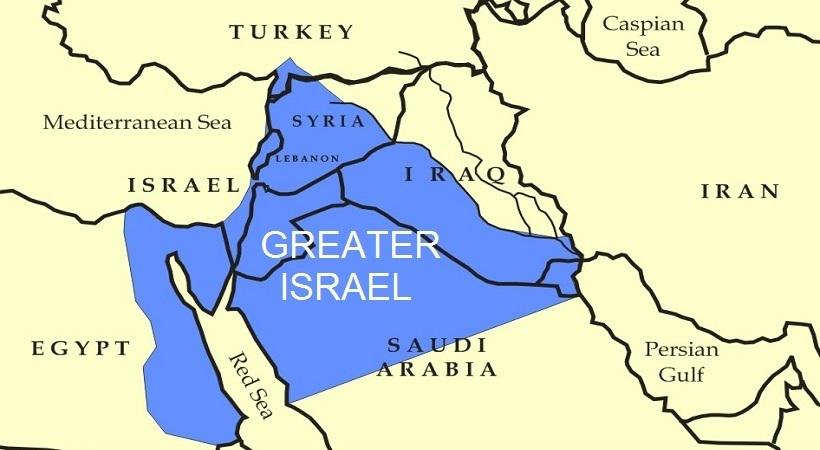
This vision has gradually materialized, with Zionists expanding their influence through puppet regimes in neighboring countries and systematically dismantling their military capabilities. Israel’s strikes on Syria on December 8, 2024, the day Bashar al-Assad’s regime fell, reportedly conducted 500 times in 48 hours, targeted strategic weapons stockpiles and destroyed Syria’s naval fleet—exemplifying this strategy.
On August 6, 2025, when i24NEWS journalist Sharon Gal asked Prime Minister Benjamin Netanyahu if he supported the “Greater Israel” vision, he replied, “Absolutely,” affirming his strong connection to it. This Zionist perspective, rooted in Revisionist Zionism founded by Ze’ev Jabotinsky in the 1920s, champions a Jewish state spanning both sides of the Jordan River, encompassing historical “Eretz Yisrael.” It prioritizes territorial maximalism, rejecting land compromises, and fosters robust national pride and military self-reliance. Netanyahu’s stance reflects the enduring influence of this nationalist ideology on Israel’s political landscape.
Zionism’s meticulously planned, long-term strategy continues to reshape the Middle East, exploiting the cowardice and incompetence of regional leaders who prioritize their survival over their people’s dignity, often at the expense of global stability. Addressing this challenge requires a strategic vision and unity within the Arab world that transcends reactive politics. Many Arab countries rely on an oil-driven economy, a fragile wealth source that could vanish rapidly, as seen in Venezuela’s collapse. Meanwhile, the expatriate populations sustaining these economies may depart as better opportunities arise elsewhere, further destabilizing the region.

 faznotes.com
Leave a comment