
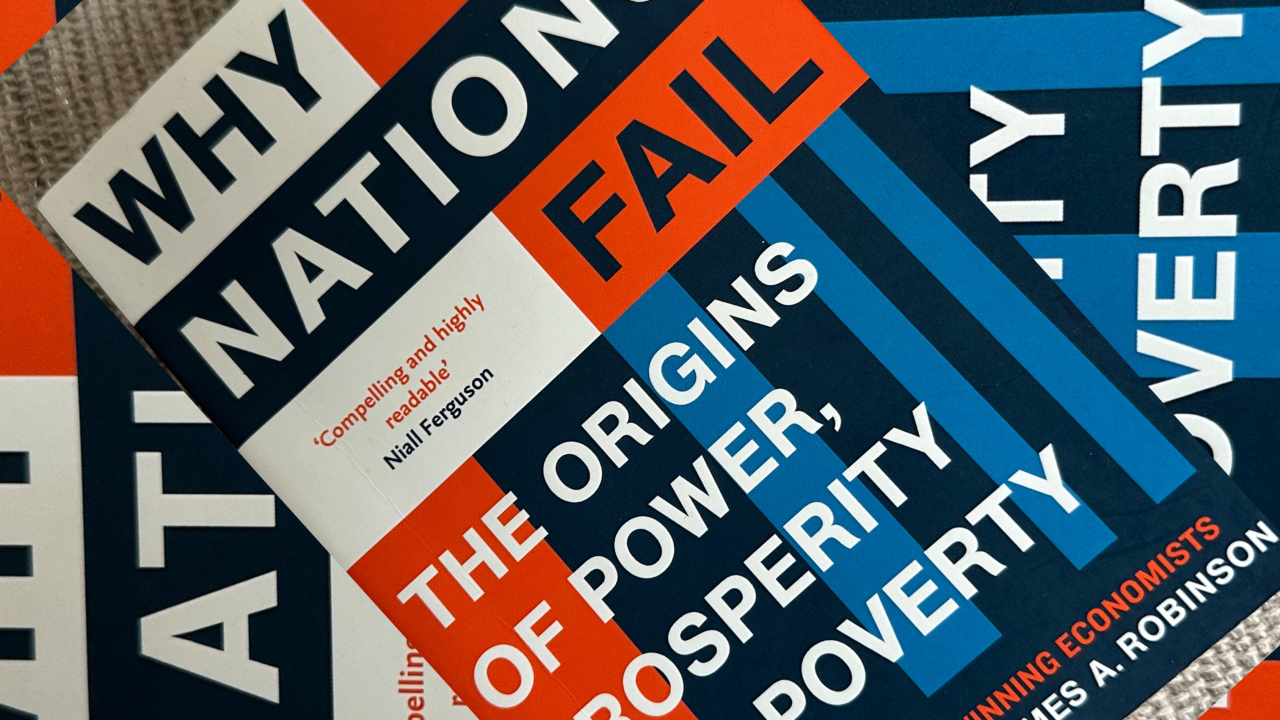


There are books that age well. Then there are books that feel like they were written yesterday. Why Nations Fail belongs firmly in the second category. Acemoglu and Robinson’s central argument is deceptively simple: nations fail not because of geography, culture, or bad luck — but because of the institutions they build and protect.
The book’s master key is the distinction between two types of institution. Inclusive institutions distribute power broadly, protect property rights, and permit creative destruction. Extractive institutions concentrate power in an elite who use it to enrich themselves and block change. Everything else in the book flows from this distinction.
Countries differ in their economic success because of their different institutions — the rules influencing how the economy works.
Nogales, Arizona and Nogales, Sonora, Mexico share geography, climate, and culture — yet Americans on one side are far wealthier. Same street, same sky. The only variable is the institution on each side of the border. That single image does more intellectual work than most books manage in three hundred pages: it demolishes geography and culture as explanations for prosperity before the authors have even warmed up.
Look at the world today and the book practically annotates itself. America’s institutional credibility is visibly eroding. The UN Security Council has been rendered functionally irrelevant — vetoed into paralysis by the very powers it was built to constrain. International law is selectively invoked, loudly when convenient, quietly abandoned when it isn’t. These are not accidents. They are the behaviour Acemoglu and Robinson predicted: extractive political systems protecting themselves by neutralising the very mechanisms designed to check them.
The vicious circle : Extractive institutions create a self-reinforcing cycle — those in power use economic resources to maintain political control, which in turn protects those resources. Any challenger who seizes power simply inherits the same system and runs the same playbook. New rulers, same structure.
The post-coup regimes of post-colonial Africa proved this repeatedly. So did every strongman who promised reform and delivered consolidation. The Soviet Union grew rapidly under authoritarian rule by mobilising resources at scale. The USSR expanded at roughly 6% annually for decades. But the authors hold firm: without inclusive institutions, elites eventually block the creative destruction that sustains growth, because that destruction threatens their position. The USSR stagnated the moment innovation would have disrupted state industries. Growth without inclusion has a ceiling. It always has.
Why Nations Fail won the Nobel Prize in Economics in 2024 — twelve years after it was published. It took that long for the committee to catch up. Read it to understand not just why nations fail, but why they keep failing the same way.