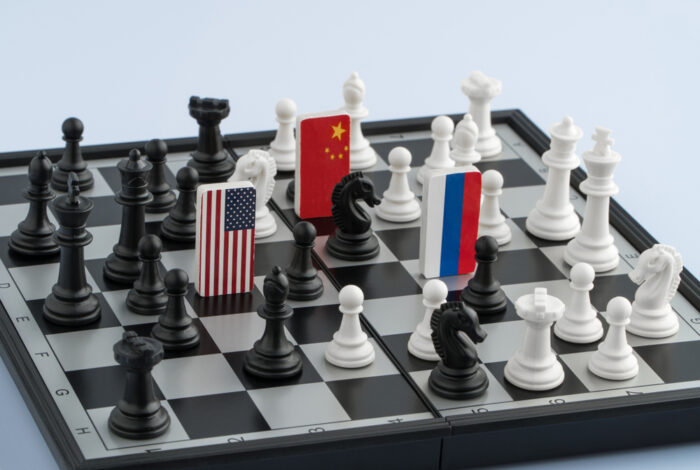

There’s a question every small or mid-sized nation must eventually answer: In a world dominated by great powers, how do you survive — and thrive — without becoming anyone’s instrument?
History’s most successful small states arrived at the same answer, independently, across centuries: Don’t choose a side. Become indispensable to all of them.
Make yourself so useful, so trustworthy, and so genuinely neutral that no great power can afford to destroy you — because doing so would cost them more than keeping you alive. This is strategic autonomy. And it’s the closest thing to a master strategy that modern history has produced for nations that lack the brute power to impose their will on the world.
The Hidden Cost of Picking a Side
When a small state fully aligns with one great power, it inherits everything that power carries — all of its enemies, wars, and moral burdens — without ever having chosen any of it.
You didn’t start the conflict. You didn’t pick the enemy. You didn’t author the policy that provoked the retaliation. But you will pay the price. In blood, in treasure, in reputation — and in every diplomatic relationship that your patron’s adversaries once offered you.
This is the hidden cost of alignment. It compounds invisibly. And then, at the moment of crisis, it presents the bill all at once.
Strategic autonomy breaks this logic entirely. The state that belongs to no one inherits nothing it didn’t choose — and builds its relationships, reputation, and prosperity entirely on its own terms.
This Idea Is Older Than You Think
The formal term “strategic autonomy” was adopted by the European Union in 2013, when the European Council called for the development of independent defense capabilities to reduce reliance on the United States. But the idea behind it reaches back much further. Its philosopher-architect was Jawaharlal Nehru, India’s first Prime Minister, who articulated it on the eve of Indian independence in 1947.
He called it Panchsheel — five principles built around sovereignty, non-aggression, non-interference, equality, and peaceful coexistence.
It was a survival doctrine for nations emerging from colonial subordination into a world already splitting into two heavily armed blocs.
The doctrine crystallised in April 1955, when 29 nations gathered in Bandung, Indonesia — representing over half the world’s population. They came together not to form an alliance, but to declare their collective refusal to be anyone’s pawn.
At its peak, the Non-Aligned Movement represented 120 nations. The doctrine was so influential that US Secretary of State John Foster Dulles felt compelled to publicly declare neutralism “immoral.” That reaction, coming from Washington, was confirmation the strategy was working.
Three Countries That Turned Neutrality Into Wealth
Switzerland didn’t stumble into neutrality — it engineered it. Codified at the Congress of Vienna in 1815, Swiss neutrality became a product the world paid a premium for. While Europe bled in two world wars, Switzerland lost neither a generation nor a city. It became home to the Red Cross, the Bank for International Settlements, and the UN’s European headquarters — not despite its neutrality, but because of it.
Singapore is perhaps the most remarkable case. A city of 5.8 million people with no oil, no minerals, no agricultural land, and no strategic depth — yet one of the wealthiest and most stable societies on earth. Lee Kuan Yew built the most efficient port in Asia, created a legal environment so transparent that multinationals made it their regional base, invited the US Navy to use its facilities without becoming a formal American ally, and maintained warm relations with China without becoming Beijing’s client. Strategic autonomy as a commercial proposition, executed with total discipline.
Austria offers perhaps the most instructive case for the Gulf in particular. The 1955 State Treaty that ended Allied occupation of Austria required permanent neutrality as its price. Austria used this obligation as an asset: it became the headquarters of OPEC, the International Atomic Energy Agency, and the UN’s Vienna centre. Austrian neutrality, like Swiss neutrality, was a product that the world paid to have available.
The Gulf has the resources, the geography, and the financial infrastructure to build exactly that kind of product — if it can maintain the political discipline to resist alignment pressure.
What This Strategy Actually Requires
Strategic autonomy is not isolation or weakness—it is engagement without dependence. You can have many partners, but none should control your core decisions.
The states that lasted — that prospered and kept their independence across centuries — were not the ones that chose the winning side in the great power competitions of their era.They were the ones that refused to play that game at all.
As the world becomes multipolar, flexibility matters more than loyalty to any single power. The states best positioned for long-term success are not those tied to one orbit, but those indispensable to many.