
Nassim Nicholas Taleb’s Fooled by Randomness is one of those rare books that genuinely challenges how you see the world — the fragility of life, the illusions we construct around success, and why wisdom, in the end, outlasts wealth. I still remember being glued to its first chapter a decade ago, rereading it as a young man.
That opening chapter is built around the encounter between a Greek philosopher and the richest king of his age. It speaks to the fundamental fragility of human beings — and, by extension, of the states they build and believe will last forever.
Solon’s Warning
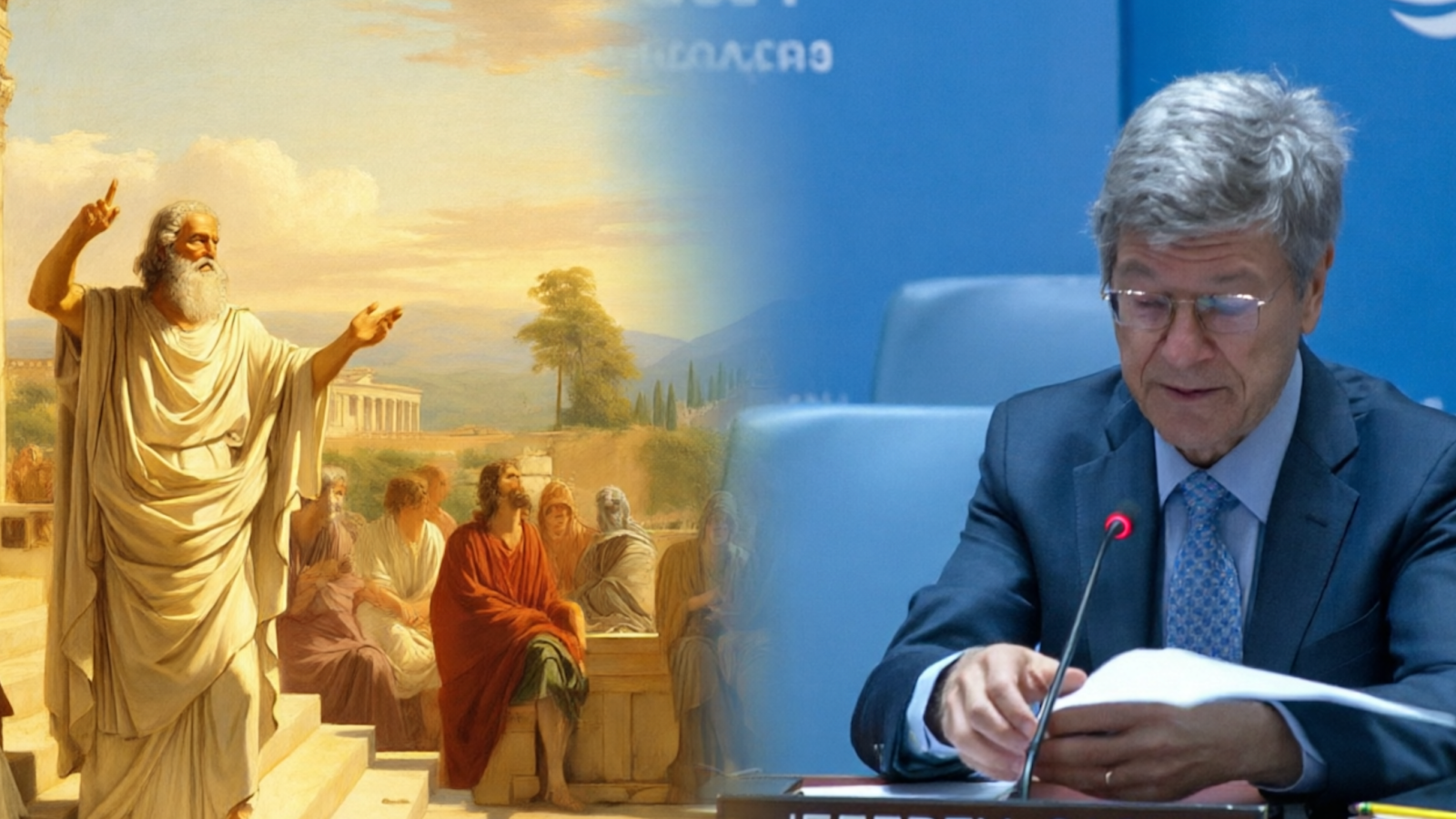
Croesus, King of Lydia, was considered the richest man of his time. To this day Romance languages use the expression “rich as Croesus” to describe a person of excessive wealth. He was said to be visited by Solon, the Greek legislator known for his dignity, reserve, upright morals, humility, frugality, wisdom, intelligence, and courage. Solon did not display the smallest surprise at the wealth and splendour surrounding his host, nor the tiniest admiration for their owner. Croesus was so irked by the manifest lack of impression on the part of this illustrious visitor that he attempted to extract from him some acknowledgment. He asked him if he had known a happier man than him. Solon cited the life of a man who led a noble existence and died while in battle. Prodded for more, he gave similar examples of heroic but terminated lives, until Croesus, irate, asked him point-blank if he was not to be considered the happiest man of all.
Solon answered: “The observation of the numerous misfortunes that attend all conditions forbids us to grow insolent upon our present enjoyments, or to admire a man’s happiness that may yet, in course of time, suffer change. For the uncertain future has yet to come, with all variety of future; and him only to whom the divinity has [guaranteed] continued happiness until the end we may call happy.”
Yet the story of Croesus has another twist. Having lost a battle to the redoubtable Persian king Cyrus, he was about to be burned alive when he called Solon’s name and shouted: “Solon, you were right.” Cyrus asked about the nature of such unusual invocations, and Croesus told him of Solon’s warning. This impressed Cyrus so much that he decided to spare Croesus’ life, as he reflected on his own fate.
Probability and the Illusion of Permanence
Solon understood a point that has obsessed science for the past three centuries: the problem of induction. Taleb calls it the black swan, or the rare event. Solon also grasped a linked issue, which Taleb calls the skewness problem: it does not matter how frequently something succeeds if failure is too costly to bear.
Taleb’s idea is unsettling because it attacks our most fundamental assumption about people and states: that their success reflects their capability. It often does not. At any given moment, the landscape of apparent success contains many people and institutions that are simply lucky fools — they don’t know it, and the serotonin boost from success makes them appear more confident, more capable, and more dominant than they actually are. The appearance reinforces itself. The track record accumulates. And everyone concludes that the success is earned.
Croesus was, in all likelihood, a skilled ruler. But how much of his extraordinary wealth was skill, and how much was the accident of ruling a gold-rich kingdom at a particular historical moment? Solon refused to answer the question by looking at the present outcome alone. He insisted on looking at the full distribution of possible outcomes — the alternative histories that could have unfolded — and judging only from there. Solon was, without knowing the term, the first probabilistic thinker in recorded history.
The Recurring Pattern
Solon’s Warning is not ancient history — it is the recurring pattern of every era, every domain, every civilisation that has ever mistaken the summit for the destination. Hitler’s Germany in 1941 stood at the peak of European power: France had fallen in weeks, Britain was isolated, Eastern Europe subordinated. His own generals warned against opening an eastern front against the Soviet Union. He ignored them. The Soviet Union absorbed twenty-six million casualties and did not break — and the empire that seemed unstoppable four years earlier was finished.
The economic graveyard tells the same story. Venezuela sat atop the world’s largest proven oil reserves, its leaders certain that the resource beneath their feet guaranteed permanent prosperity. It became the single largest economic collapse outside of war in at least forty-five years, with inflation eventually exceeding ten million percent. The oil did not run out. The certainty did. Lehman Brothers survived the Great Depression and two world wars before collapsing in a single weekend, because its leaders confused a long run of luck with structural invincibility.
The pattern is identical across every century and continent. Success generates the serotonin of certainty. That certainty produces the decision that ignores the cliff. And the cliff arrives precisely when everything looks most secure.
Strategic Risk and Modern States
Solon’s modern equivalent is Professor Dr. Jeffrey Sachs — not because he lectures kings on happiness, but because he has spent decades warning resource-rich nations that their wealth is not destiny. His credibility is real: in 1985, at the request of Bolivian President Víctor Paz Estenssoro, he helped design an economic stabilisation programme that brought hyperinflation of nearly 14,000% under control. He has since advised heads of state across more than 125 countries. His co-edited volume with Nobel laureate Joseph Stiglitz, Escaping the Resource Curse, laid the theoretical foundation for how sovereign wealth must be governed in resource-rich nations like the Gulf states.
When the architect of the Gulf countries’ financial model warns that dangerous alignment with the US and Israel could cause the cities built upon it to be blown up by entering a war with Iran, the response is not to tell him to mind his own business.
The expatriate population — the backbone of Gulf economies — is not permanent infrastructure. Unlike capital or real estate, people make individual calculations about risk. History has shown that they leave rapidly in the face of genuine threat. The assumption that they will remain through any crisis is, in Taleb’s precise terms, foolish optimism: a future imagined as a steady continuation of the present, with the black swans quietly edited out.
In a March 2026 interview, Sachs warned that wealthy Gulf cities remain physically vulnerable despite their prosperity, arguing that entering the current major conflict between the US and Iran could undermine the very conditions that made them successful. The broader principle echoes Solon’s warning: prosperity does not eliminate fragility. The question is not whether his warning is impolite. It is whether you are about to make Croesus’s mistake.
Invoking Henry Kissinger, Jeffrey Sachs echoed a geopolitical law that history has validated across every era: to be an enemy of the United States is dangerous, but to be a friend is fatal. The enemy faces American power. The ally faces the consequences of American decisions — made in Washington, for American reasons without consulting the ally who will absorb the retaliation.
The Singapore Model
There is another model available — one that addresses both economic resilience and geopolitical vulnerability simultaneously. It sits at the intersection of Sachs’s prescriptions and Taleb’s framework. Singapore transformed itself from a resource-poor trading port into one of the wealthiest and most strategically resilient states in the world. It built substantial sovereign wealth while maintaining an unusually disciplined form of strategic autonomy. Despite existing in one of the world’s most competitive geopolitical regions, Singapore has consistently avoided becoming the direct target of major-power confrontation.
Taleb’s skewness warning applies directly here. A strategy that wins ninety-nine times and fails catastrophically once is not a good strategy. It is a delayed catastrophe. The Gulf’s current alignment calculus must be evaluated not by its recent wins, but by the magnitude of what a single loss would cost.
For states, as for individuals, resilience matters more than appearances of strength.
The states that lasted — that prospered and kept their independence across centuries — were not those that chose the winning side in the great power competitions of their era. They were the ones that refused to play that game at all. As the world becomes genuinely multipolar, flexibility matters more than loyalty to any single power. The states best positioned for long-term success are not those tied to one orbit, but those indispensable to many.