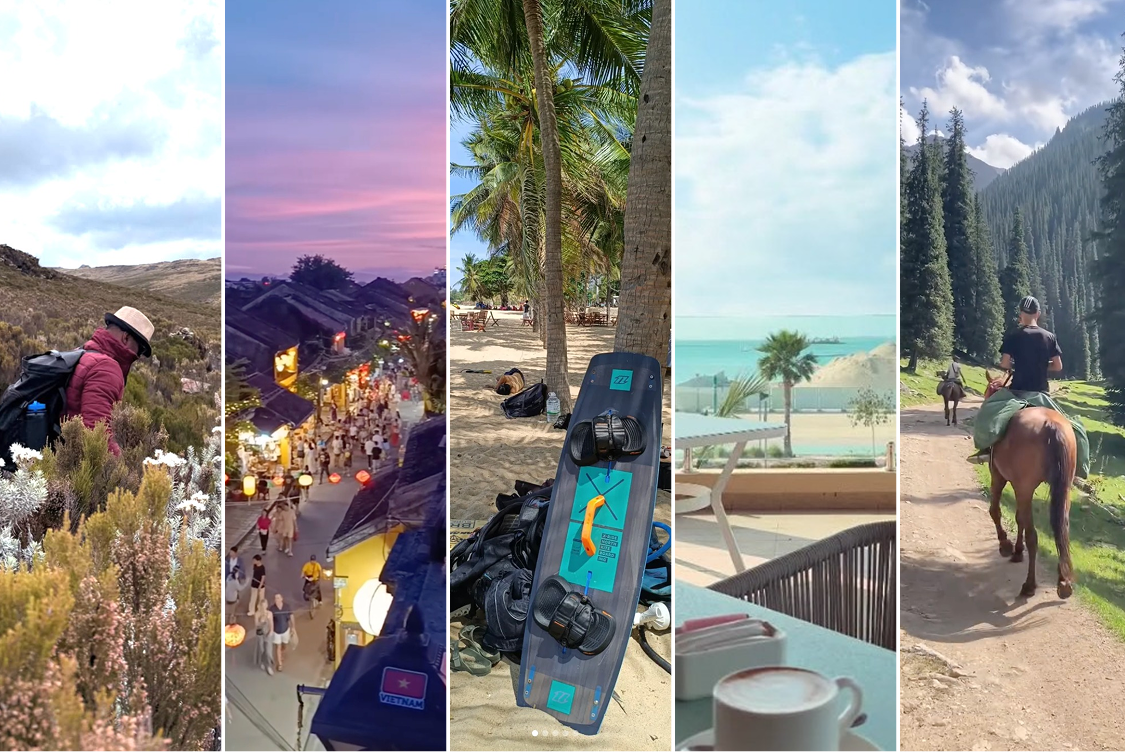


While travelling, changing places once or twice a week can easily disrupt a regular fitness routine. Most workouts depend on a gym, equipment, and a predictable schedule.What you really need is a routine that travels with you—one that requires nothing more than your body weight, a small amount of floor space, and something you can safely use as resistance, such as a backpack, a couple of water bottles, or whatever is available.
After years of traveling, you learn that one of the best ways to prepare for an unpredictable world is simply to get good at adapting. Travel constantly pushes you outside your comfort zone. New places, unfamiliar routines, changing schedules, different environments—you quickly learn that things rarely go exactly as planned. Eventually, you stop trying to control every variable and start learning how to adapt to whatever comes your way.
There’s a line from Robert Greene’s The 48 Laws of Power that captures this idea beautifully:
“Instead of taking a form for your enemy to grasp, keep yourself adaptable and on the move. Accept the fact that nothing is certain and no law is fixed. The best way to protect yourself is to be as fluid and formless as water; never bet on stability or lasting order. Everything changes.”
The lesson applies to fitness too. If a workout only works when there is a particular gym, a particular machine, or a perfectly predictable schedule, it isn’t really an adaptable fitness routine. The best routine is one that adapts to you — and wherever you happen to be.
But before committing to any routine, there is a more important skill to develop: Listen to the body. Notice how it responds to different foods, climates, sleep patterns, levels of fatigue, and types of movement. Pay attention to the mind too. Notice what happens when you’re tired, bored, distracted, stressed, or simply not in the mood to train.
Over time, patterns begin to emerge. Years of different activities have gradually distilled down to three fundamental movements:
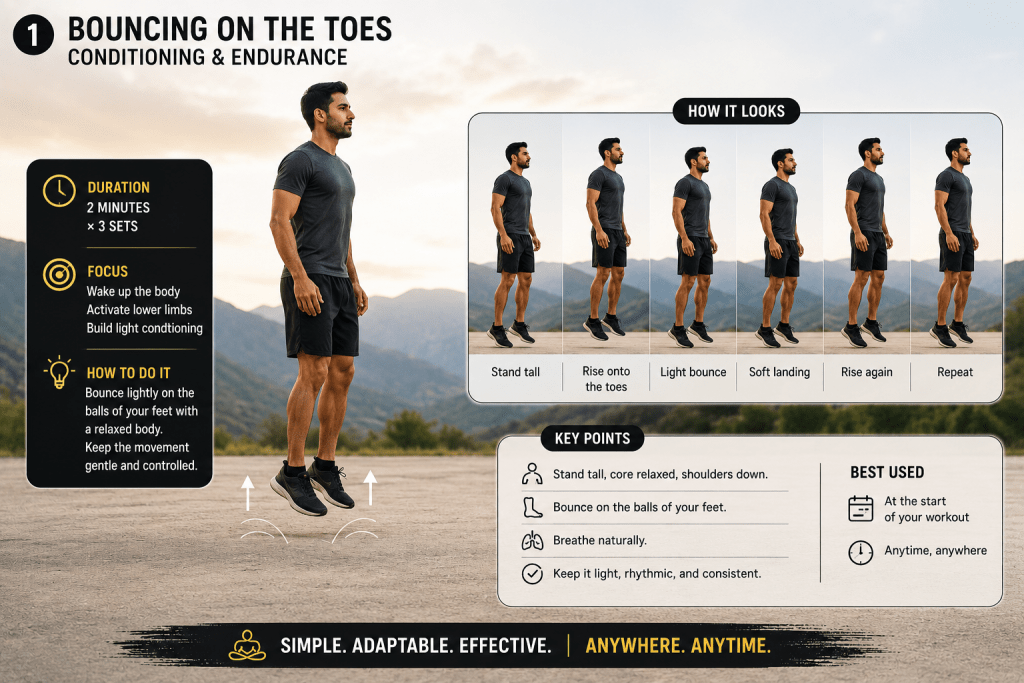
1. Bouncing on the Toes — Body Conditioning
Bounce lightly on the balls of the feet with a relaxed body. Keep the movement gentle and controlled rather than turning it into a high-impact jump. It is a simple way to wake up the body, get the lower limbs moving, and build a little conditioning before the strength movements. Video demonstration
2. Squat-to-Press — Strength + Conditioning
Hold a water bottle, backpack, or any manageable weight at shoulder height. Squat down under control. As you rise, drive through the feet and engage the core. As you reach full standing height, bring the chest up, keep the back strong and neutral, and press the weight overhead. Lower it back to the shoulders and repeat. Video demonstration
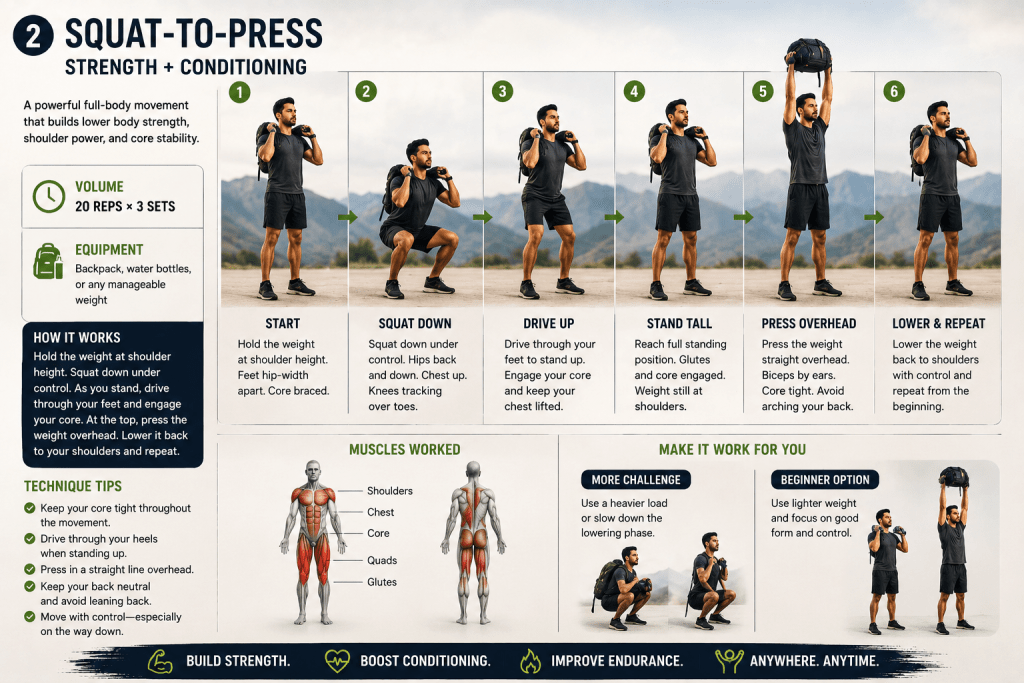
If more time and appropriate resistance are available, this can also be separated into two movements: squats first, followed by overhead presses.
3. Hindu Push-Up — Upper Body + Mobility
Start with the hips high. Swoop forward and down, then extend through the chest before returning to the starting position. The movement combines pushing strength with movement through the shoulders, chest, and spine. Hindu push-up demonstration

If a full Hindu push-up is too difficult, use a cobra-style press-up instead. Lower the body to the floor, place the hands beside the chest, and gently press the upper body upward while keeping the hips and legs grounded. This can be used until sufficient strength is developed for the full movement. Alternative cobra demonstration
These three movements aren’t meant to be a complete definition of fitness. They are simply the minimum effective practice that can be carried anywhere. Because fitness isn’t only about strength, muscle, or cardiovascular capacity. The body and mind need to be trained together. That’s why, when time allows, Surya Namaskar from yoga and the five exercises of Falun Gong (Falun Dafa) can also become part of the practice.
Surya Namaskar
Surya Namaskar, or Sun Salutation, is a flowing sequence of postures traditionally linked with the breath. It moves the body through multiple positions while developing mobility, coordination, strength, and body awareness. Surya Namaskar
Falun Gong
Falun Gong (Falun Dafa) includes four standing exercises and a fifth seated meditation. The practice emphasizes slow, deliberate movements, stillness, breathing, and meditation. Within its traditional framework, the exercises are understood in terms of qi and the body’s energy channels. Five Falun Dafa exercises
And whenever possible: Walk. Hike. Trek. Swim. Get outside. A three-day high-altitude trek can be a powerful reset — physically, mentally, and psychologically.
The objective isn’t to build the perfect training program. It’s to create a simple, adaptable practice that keeps the body moving and the mind grounded — wherever you happen to be.