

On February 28, 2026, the United States and Israel launched Operation Epic Fury — nearly 900 strikes on Iran in the first twelve hours. In its opening hours, UNICEF reported, 168 girls were killed when a strike hit a girls’ elementary school in Minab, in southern Iran. The same lethal opening wave assassinated Iran’s Supreme Leader Ali Khamenei and killed a swathe of high-ranking Iranian politicians and military officials. Israel called its campaign Operation Roaring Lion. It was billed as a decisive, surgical operation — regime change, and the dismantling of Iran’s nuclear and missile capacity once and for all.
The war one man spent thirty years building toward
This war was the culmination of a campaign waged relentlessly for three decades by Benjamin Netanyahu — Israel’s current prime minister, a master manipulator, the revisionist-Zionist heir to Likud, and a figure whose political career has brought immense misery to much of the region. He rose to power amid the poisoned atmosphere surrounding the 1995 assassination of Yitzhak Rabin, the Israeli prime minister who had signed the Oslo Accords with the PLO — a climate of incitement he helped inflame. From the beginning, his warnings about Iran were constant, and always the same: an Iranian bomb was only a few years away.
In 1992, as a member of the Knesset, Netanyahu made his first major prediction, telling parliament that Tehran was within three to five years of a nuclear weapon. In 1995, in his book Fighting Terrorism, he formalized the argument, warning the West that an Iranian nuclear threat was imminent. In 2002, he testified before a U.S. congressional committee pushing for the invasion of Iraq, while warning that Iran and Iraq were both racing toward nuclear capability. In 2012, he carried a cartoon diagram of a bomb to the UN General Assembly to draw a literal “red line” against Iranian enrichment. The dates changed; the deadline never arrived. What arrived, three decades later, was Operation Epic Fury — the war his rhetoric had been rehearsing all along, now fought with American forces, in a fight that was never in America’s interest.
Who fights, and who recedes
Six months on, the marketing has collapsed utterly. The offensive that Netanyahu spent thirty years pressing for became the quagmire America now owns. And contrary to the founding assumption — that Iran would crack — it did not. Anyone who follows geopolitics saw the pattern in the aftermath of the American invasions of Afghanistan in 2001 and Iraq in 2003: Iran understood it was encircled, and it had spent twenty years preparing for exactly this. The Iraq plan did not go as Washington drew it up; it trapped America in an occupation and handed effective control to a Shia-aligned majority. Iran learned that lesson better than its enemies did.
Look at the arithmetic of exposure. The opening blow was joint. But following the April 2026 ceasefire, Israel largely receded from active operations — while American forces stayed pinned across the Gulf, absorbing the retaliation. Israel got the war it wanted. America got the bill, the body count, and a standoff with no endgame.
This is the structural point the strategic analogies keep circling. A tactically overwhelming force walked into an adversary built specifically to absorb tactical punishment and convert it into political attrition — General Võ Nguyên Giáp’s Vietnam doctrine, industrialized: cheap dispersed drones against multimillion-dollar interceptors, underground missile infrastructure invisible from the air, ballistic missiles of every kind — hypersonic, cluster, solid-fuel — and a population and leadership that treats endurance as its own kind of victory. Iran did not need to win a battle. It needed to make every engagement cost more than the last, until American political will ran out. It reconstituted its leadership within weeks; the Revolutionary Guard consolidated wartime power rather than fracturing. The single assumption the operation rested on — that decapitation would break the regime and spark an uprising — simply failed.
The economics of the trap
By any military accounting, this was one of the most striking asymmetric campaigns in history — tens of billions in damage to the equipment and economies of Gulf allies who host American and Israeli bases.
For Israel, the toll since February 28 has been heavy: roughly 26 killed and thousands wounded. The Finance Ministry added some 35 billion shekels (about $11.5 billion) to its 2026 budget for direct war costs, with roughly $7.2 billion of that going to air defense and interception alone. Home Front Command restrictions and mass mobilizations paralyzed commerce, bleeding an estimated $3 billion in lost productivity for every week they held.
For the United States, active operations in the first five months ran an estimated $35–37 billion, with the Pentagon requesting tens of billions more to replenish depleted stocks. Repairing struck facilities across the region runs into the billions. Continuous strikes and the naval blockade of the Strait pushed the Navy into a funding crunch severe enough to shift money out of payroll and delay maintenance. American military casualties, by contrast, were kept low by containment and interceptors.
For the Gulf states, the damage struck at the foundation of their economic model. Iranian counter-strikes on GCC states hosting U.S. forces killed dozens; early waves involved thousands of missiles and drones fired across the GCC and Jordan, devastating energy, industrial, and transport infrastructure. Traffic through the Strait of Hormuz collapsed by roughly 80–95% — stranding the wealth of states whose fortunes ride on the quarter of global seaborne oil and the fifth of the world’s LNG that pass through it. Saudi Arabia’s oil sector contracted sharply, forcing Riyadh and Aramco to raise fresh debt. The IMF projects Qatar’s GDP to fall 8.6% — the steepest drop in the GCC.
Then there are the world’s poor: higher fuel and fertilizer prices drove the UN food price index to its highest level since early 2023, and the World Food Programme estimates that an additional 7.1 million people in Somalia, Afghanistan, and Sri Lanka are now struggling to eat. UN Secretary-General António Guterres warned that the world’s food supply had been turned into “collateral damage.” Airlines, carmakers, and Gulf economies absorbed the rest — the Middle East’s carriers alone facing a projected $4.3 billion loss for the year.
The critics America can’t wave away
What makes this moment distinct is not that there are war critics, but who they are. This is no fringe. It is a cross-ideological coalition of realists, economists, retired officers, and national-security veterans who agree on almost nothing else and have converged on a single verdict: a strategic blunder of the first order.
John Mearsheimer, the dean of realist international-relations theory, has called it one of the great strategic blunders in American history — a war of choice fought on maximalist goals it could never reach. Economist Jeffrey Sachs has denounced the entire posture as reckless and lawless, warning that a closed Strait and spiking energy prices threaten global economic damage far beyond the battlefield — and, bluntly, that none of it served America’s interest. Harvard’s Stephen Walt and scholars like Glenn Diesen frame it as a catastrophic distraction, draining American power into a Middle Eastern cul-de-sac while real strategic competition sits elsewhere. Regional experts like Vali Nasr argue that the campaign fundamentally misread Iranian resilience and abandoned the diplomacy that might have contained it.
From the military side, retired Colonel Douglas Macgregor warned early and loudly about the vulnerability of U.S. forces massed in the Gulf and the folly of a fight around the Strait of Hormuz — warnings that now read like a forecast. Tucker Carlson attacked the intervention as a betrayal of the promise to stop dragging America into other nations’ wars. Behind them stand dozens of retired flag officers making the same case in the sober language of cost and risk. Their consensus is damning: objectives never clearly communicated to the public or to allies, an intelligence assumption about Iranian brittleness that proved false, a foreseeable economic weapon — the Strait — left unguarded, and no credible plan for the day after.
Where is Israel now?
Amerikaner, denken daran! carries an ugly history, and it is worth naming that rather than hiding it. But the question underneath it is legitimate and unavoidable: when a war is launched to serve a partner’s decades-long strategic obsession, and that partner recedes while your own exposure deepens, whose interest was actually served?
The critics arrayed against Epic Fury — Mearsheimer, Sachs, Walt, Nasr, Macgregor, Carlson, and the ranks of officers behind them — share no sympathy for Tehran. They share a colder judgment: that the United States let itself be maneuvered into a war it could not win, on terms it did not set, and is now trapped in an asymmetric standoff with no way out. That is the thing worth remembering. Not who cheered when the bombs fell — but who was left holding the wreckage when the cheering stopped.
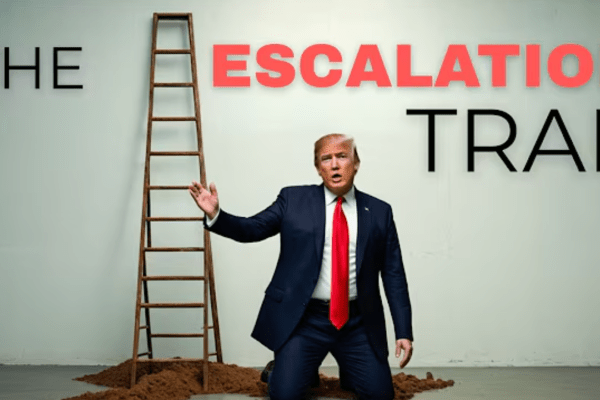
Israel started this war. Six months on, the question the caption forces is the one Washington still cannot answer: where is Israel now — and why is it America still standing in the fire?