

A year ago, the AI story looked very different: BCG’s 2025 study found that only 5% of companies were getting real value from AI. Today, the question has shifted. Can organisations turn AI’s growing capabilities into measurable business value without losing control of the decisions and actions it takes?
Value: spreading, but unevenly
BCG’s 2026 Applied AI Index suggests that nearly half of companies now generate meaningful value from AI, up from just 5% in its 2025 study. But PwC’s 2026 Global CEO Survey of 4,454 CEOs paints a more cautious picture: 56% reported neither higher revenue nor lower costs from AI over the preceding year. Only one in eight (12%) got both: more revenue and lower costs at the same time.
The two findings are not contradictory. They highlight the difference between adopting AI, getting some benefit from it, and fundamentally transforming a business. The strongest performers are not necessarily those spending the most on technology. They are the ones redesigning workflows, defining clear business objectives and measuring results.
In McKinsey’s research, 55% of AI high performers had fundamentally redesigned their workflows, against 20% of other companies. AI should begin with the problem a business needs to solve, not with the technology it wants to deploy.
Capability: stronger, but uneven
AI capabilities continue to advance rapidly. Stanford’s 2026 AI Index documents substantial gains in software engineering, scientific reasoning and mathematical problem-solving, and puts organisational adoption at 88%.
These advances sit alongside real limitations. The same models that excel on complex benchmarks can still fail at seemingly simple tasks, and documented AI incidents continue to rise. In 2024, a Canadian tribunal ordered Air Canada to compensate a customer after its chatbot gave him wrong information about bereavement fares, rejecting the airline’s argument that the chatbot was responsible for its own answers. Replit’s AI coding agent deleted a company’s production database despite instructions not to, and Samsung staff leaked confidential code into ChatGPT. Many more cases are recorded in the independent AIAAIC Repository. Wrong answers, unauthorised actions and leaked data each need a different safeguard, so businesses should test AI against their own requirements rather than assume that headline performance guarantees reliability.
Control: the next challenge
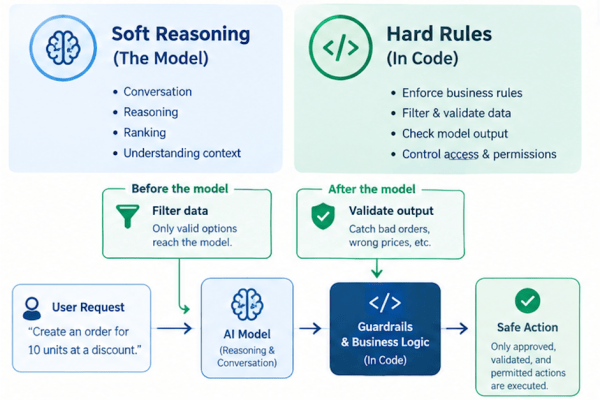
AI agents are moving beyond answering questions to executing tasks, accessing systems and making decisions. BCG found that 42% of companies expect agents to act autonomously by 2030, yet only 5% have implemented all six of its essential agent controls.
BCG’s six agent controls, with each one’s share of the value the controls create:
- Memory and context (32%). Decide how agents use, store and recall memory and context, because memory can spread errors and sensitive information as easily as it spreads learning.
- Scope and oversight (21%). Define each agent’s purpose, scope, level of autonomy and the human oversight it needs, including which actions it may take and in what context.
- Evaluation and rollback (18%). Set evaluation criteria, release gates, continuous monitoring and rollback mechanisms, so problems are caught after launch, not only before it.
- Tools and integration (13%). Standardise tool integrations, APIs and agent registries, so the company can see which agents are running, what they can access and how they interact.
- Ownership (9%). Give every material agent a named owner across business, technology and risk, with authority to change, suspend or stop it.
- Security (7%). Apply runtime security controls, audit trails and cost guardrails, so every agent action can be constrained as it happens and reconstructed afterwards.
The two most valuable controls are the least technical. Together, defining what an agent knows (memory and context, 32%) and what it is for (scope and oversight, 21%) accounts for more than half the value. Those are business decisions before they are engineering ones.
The Gulf: ahead on ambition, behind on data
Nowhere is this sharper than here in the Gulf. The ambition is real: the region isn’t just adopting AI. It’s building it.
- Infrastructure. Stargate UAE, a 1-gigawatt AI cluster built by G42 with OpenAI, Oracle, Nvidia, Cisco and SoftBank, sits within a planned 5-gigawatt UAE–US AI campus. Its first 200 megawatts are due to go live in 2026. Separately, Microsoft and G42 are adding another 200 megawatts as part of a US$15 billion commitment. In Saudi Arabia, PIF and Google Cloud are building a US$10 billion AI hub.
- Home-grown models. Falcon from Abu Dhabi’s TII. Jais, built by G42’s Inception with MBZUAI. ALLaM from Saudi Arabia’s SDAIA.
- National champions. Saudi Arabia’s HUMAIN is building AI capacity at national scale.
- Capital. Announced AI-related investment in the UAE passed Dh543 billion (about US$148 billion) across 2024 and 2025. In 2025 alone, Mubadala put US$12.9 billion into AI and digitalisation.
And the intent runs through companies too. In PwC’s survey, 70% of Middle East CEOs say they have a clear AI roadmap, against 51% worldwide. 82% say their culture is ready for AI. More than a third have already built it into their products, against fewer than one in five globally.
Then comes the uncomfortable number. Only 22% of Middle East CEOs, and just 16% in the GCC, say their AI tools can reach all the data they need. Worldwide, it’s 29%.
Resilience is part of the same question. After drone strikes on AWS data centres in the region in March, AWS later said it could not restore access to data hosted exclusively in its Bahrain region, while customers with backups elsewhere recovered. Keeping data within a jurisdiction does not guarantee that it will remain accessible during a major disruption. Residency and resilience have to be designed together.
Economics: the bill is coming due
A further question concerns the economics of AI infrastructure. Gartner says the companies building AI data centres would need about US$8.5 trillion in revenue by 2030 just to cover their spending and earn a fair return. It expects them to make no more than US$3.6 trillion. That leaves more than US$3.5 trillion of investment at risk of being written down.
That’s a forecast, not a loss. But it tells you where this is heading: consolidation among the providers, and much harder questions about ROI inside every business that uses AI.
In China, it’s already more than a forecast. By late October 2026, the STAR50 index of AI and chip companies had fallen about 40% from its July high in under four months, wiping out roughly US$480 billion in market value. The causes will sound familiar: stretched valuations, doubts about how much real demand there is for AI, and fears of new curbs on Chinese technology exports.
What to do
- Start with purpose. Decide what each AI system and agent is for, and what it may decide, before you pick a tool.
- Make fewer, bigger bets. Rebuild a handful of important workflows end to end. Stop running dozens of pilots.
- Fix the data. Give AI governed access to what it needs, and make sure you can get that data back.
- Control agents from day one. An owner, permissions, a log, and an off switch. For every agent.
- Measure in the P&L. Track the cost of each successful outcome, not the cost of each token.
Conclusion
AI is becoming more capable, but capability alone does not create value. The organisations that succeed will combine technology with sound business judgement, reliable data, effective governance and financial discipline.
In the Gulf, the next phase of progress will depend not on how much AI infrastructure is built, but on how effectively it is turned into productive, resilient and commercially sustainable businesses.