

In today’s enterprise landscape, the word “agentic” is everywhere. Vendors tout “AI agents” that promise to revolutionise workflows, cut costs, and accelerate decision-making. Yet despite millions in investment, most corporate AI initiatives remain stuck in pilot stage—demonstrating novelty but failing to deliver measurable, scalable return on investment.
The problem isn’t the technology. It’s the terminology—and the dangerous conflation of automation with agency.
Not every chatbot with a plugin is an agent. Not every RAG pipeline or Zapier workflow wrapped in an LLM interface qualifies as agentic intelligence. If a system cannot autonomously plan, act, and learn in pursuit of a defined business outcome, it is not agentic AI. It is, at best, sophisticated assistance.This distinction is not academic. It is strategic—and financial.
The Three Imposters of “Agentic” AI
Three categories of tools are routinely mislabeled as agents, creating unrealistic expectations and setting projects up for failure:
- The Enhanced Chatbot Fluent, responsive, and context-aware—but entirely reactive. It answers questions; it never initiates action. It summarizes reports; it never owns the outcome those reports are meant to influence. This is augmentation, not autonomy.
- The Scripted Automation Robot Reliable on linear, predictable paths—but brittle in the face of ambiguity. When a customer complaint deviates from the playbook, it stalls. It follows instructions; it doesn’t formulate a Plan B. This is digital assembly-line work, not intelligent agency.
- The RAG Pipeline Powerful for grounding responses in real data—but passive by design. It retrieves, contextualizes, and generates. It does not decide what to do next, nor does it execute changes in the real world. Memory without action is not agency.
These tools have value. But calling them “agents” breeds an expectation gap: executives anticipate autonomous problem-solvers, only to receive glorified assistants.
What Makes an AI System Truly Agentic?
A genuine Agentic AI is a digital worker—an autonomous entity that operates within a closed-loop cognitive framework: Plan → Act → Learn.
- Goal: It starts with a high-level business objective (“Minimize supply chain disruptions”), not a narrow task (“Find delayed shipments”).
- Plan: It decomposes that goal into subtasks, dynamically selecting tools, APIs, and data sources based on real-time context.
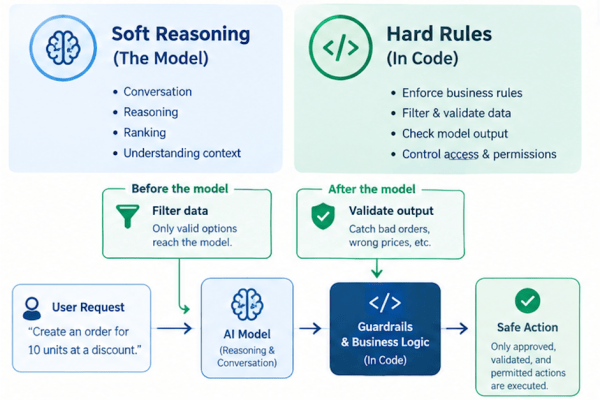
- Act: It executes multi-step workflows across CRMs, ERPs, and communication platforms—with delegated authority to change system states without step-by-step human approval.
- Learn: It evaluates outcomes, refines its decision logic, and adapts future behavior to improve performance.
This loop must be uninterrupted. Insert a human for planning or approval at every step, and you collapse back into assisted automation.
The Four Capabilities That Define Real Agency
To cut through the marketing noise, leaders must audit any “agentic” system against four concrete capabilities:
- Autonomous Goal Decomposition Can it translate “Optimize Q3 marketing spend” into its own research, reallocation, and creative adjustment plan—without a human blueprint?
- Dynamic Tool Orchestration Faced with a service failure, does it decide whether to check inventory, query support logs, or issue a refund—based on context, not a rigid script?
- Permissioned Execution Can it complete an end-to-end process—like remediating a compliance gap, from detection to documentation—with only final oversight, not micromanagement?
- Outcome-Based Strategic Learning After running a procurement cycle, does it analyze supplier performance and lead times to autonomously refine its negotiation strategy for next time?
If the answer to any of these is “no,” you’re not dealing with an agent. You’re using a tool.
From Cost Center to Strategic Asset
When AI systems own outcomes—not just tasks—they shift from being cost centers to strategic assets. Here’s how:
Revenue Protection at Scale
An agentic supply chain monitor doesn’t just flag delays—it proactively reroutes shipments, negotiates with alternate carriers, and updates customers, preventing millions in lost sales.
Operational Velocity
A procurement agent can compress a 10-day sourcing cycle into 4 hours by autonomously evaluating suppliers, placing orders, and tracking deliveries—freeing procurement teams for strategic negotiation.
Risk Mitigation by Design
In regulated industries like healthcare or finance, agentic compliance monitors continuously audit transactions, detect anomalies, and auto-remediate low-risk issues—reducing regulatory exposure before fines occur.
Scalable Innovation
Imagine a product innovation agent that ingests customer reviews, social trends, and competitor launches—then proposes, prototypes, and tests new formulationsall within predefined guardrails. This turns insight into action at machine speed.
Real-World Impact: Where Agentic AI Delivers
- Healthcare: An agent monitoring ICU vitals detects early sepsis markers, synthesizes patient history, alerts clinicians with actionable insights, and refines its alert sensitivity based on treatment outcomes.
- Manufacturing: An agent predicts equipment failure, schedules maintenance during downtime, auto-orders parts, and correlates interventions with yield data to optimize future decisions.
- Retail: An agent analyzes weather, local events, and social sentiment to dynamically shift inventory, trigger markdowns, launch hyper-local promotions, and measure lift—then uses those results to refine its algorithm.
These aren’t hypotheticals. They’re emerging deployments where AI doesn’t just assist—it takes responsibility.
A Call to Leadership
The question is no longer “Are we using AI?” but “What measurable business results is our AI autonomously delivering—without constant human oversight?”
Before approving any “agentic” initiative, apply this litmus test:
Does it decompose goals? Does it choose tools dynamically? Does it execute with authority? Does it learn from outcomes?
If not, it’s automation—not agency.
The path to genuine transformation lies not in adopting more AI tools, but in deploying digital workers capable of ownership. That is the threshold where technology ceases to be a cost center—and becomes a strategic asset.