
In July 1944, delegates from 44 nations met at a hotel in Bretton Woods, New Hampshire, to design the financial order of the postwar world. Much of today’s world was not in the room. India, Nigeria, Indonesia, Kenya, and most of Africa and Asia were still colonies, their futures largely determined by the empires that ruled them. The rules written during those three weeks, and the power structure behind them, still shape how money moves across the planet eight decades later.
We live in a world of 193 sovereign nations, yet the plumbing of global finance still answers to a handful of them. This arrangement is no longer defensible, and that a truly independent, democratic global financial system is both necessary and achievable.
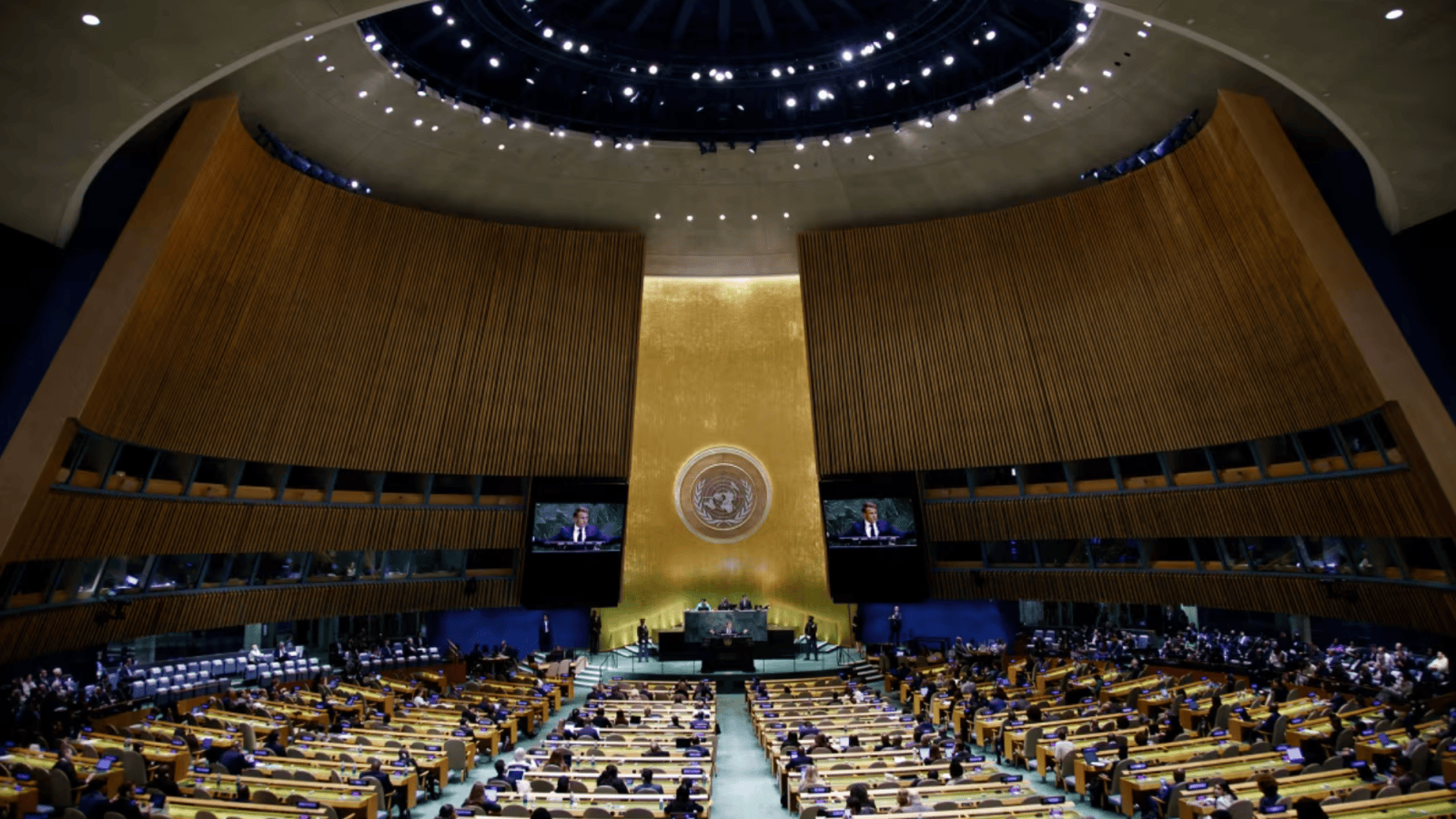
Each September, nearly every nation on the planet sends a representative to the annual General Debate of the United Nations General Assembly, held at United Nations Headquarters in New York City, to speak about its concerns, its grievances, and its vision of the world. By tradition, Brazil speaks first and the host nation, the United States, second. Presidents of great powers and prime ministers of small island states stand before the same audience and speak, at least in principle, to all of humanity.
These speeches are only half the story. The other half is what those leaders do when they return home. Comparing the words spoken in New York with the policies practised in their own capitals reveals a great deal about a nation: about its leaders and about the collective consciousness of its people.
Nowhere is this gap more visible than on the question of Israel and Palestine. Year after year, leader after leader has taken the podium to denounce Israel’s aggression and the fear it has spread across the region. Yet some of the same governments have normalised relations with Israel and maintain trade and security ties with it, even as their representatives speak with outrage in New York. The distance between the podium and the policy says more about those leaders than any speech.
That gap is not only a question of sincerity. It is also a question of power. Many governments say one thing in New York and do another at home because their real choices are constrained: by dependence on foreign security guarantees, on access to markets, and on a financial system that can reward or punish them. A nation whose reserves can be frozen and whose banks can be cut off from the world is not free to act on its convictions. Its words are free; its actions are not.
Why the current system fails the world
1. The rules can be rewritten by one country alone.
The Bretton Woods system rested on a promise: the US dollar would be convertible into gold at a fixed price, and other currencies would be pegged to the dollar. The whole world organised its reserves around that promise. On 15 August 1971, President Richard Nixon ended it in a televised address, without consulting the other members of the system. He also imposed a 10% surcharge on imports. When European finance ministers protested at a meeting later that year, US Treasury Secretary John Connally reportedly replied that the dollar was “our currency, but your problem.” Within two years the fixed-rate system had collapsed entirely. The architecture that governed the world’s money had been dismantled by the decision of a single government, and the rest of the world was left to adjust. That remains the defining weakness of the system today: a global currency governed by national interest.
2. Finance has become a weapon.
Over the past half-century, control of the world’s financial plumbing has repeatedly been used by America to reach into other nations’ treasuries.
Iran, 1979. In February 1979, the Islamic Revolution overthrew the Shah, a close ally of the United States. On 4 November that year, revolutionary students seized the US embassy in Tehran. Ten days after the seizure, Washington froze around $12 billion of Iranian government assets held in American banks and their foreign branches. It was the first modern large-scale freeze of a nation’s reserves, and it became the template for every case that followed.
Iraq. After Iraq’s invasion of Kuwait in 1990, Security Council sanctions froze its assets and cut it off from world trade for more than a decade, with severe humanitarian consequences for ordinary Iraqis. Even after 2003, Iraq’s oil revenues continued to flow through an account at the Federal Reserve Bank of New York. In 2020, when Iraq’s parliament voted to expel foreign troops, Washington reportedly warned Baghdad that its access to that account could be restricted. A sovereign nation’s income from its own oil still passes through another country’s central bank.
Libya. In 2011, as conflict broke out, Libyan state assets worth tens of billions of dollars were frozen under Security Council and national measures, among the largest asset freezes ever at the time. The government those measures targeted fell that same year. Yet a large share of the Libyan Investment Authority’s holdings, wealth that belongs to the Libyan people, remained frozen for more than a decade afterwards, while the country struggled to rebuild.
Iran, again. In 2012, Iranian banks were disconnected from SWIFT, the global financial messaging network. It was the first time an entire country’s banking system had been cut off. Reconnection followed the 2015 nuclear agreement. When the United States withdrew from that agreement in 2018 and reimposed sanctions, Iranian banks were disconnected again, even though the other signatories still supported the deal. Billions of dollars in Iranian oil revenues have sat in foreign bank accounts for years, released or re-frozen according to the politics of the moment.
Syria. From 2011, American and European sanctions froze Syrian state assets and isolated its financial system. When the government fell in December 2024, much of the sanctions architecture remained in place for months, restricting reconstruction funds and trade for a population that had already endured more than a decade of war.
Venezuela. In 2019, Venezuela’s central bank was unable to retrieve roughly a billion dollars’ worth of its own gold stored at the Bank of England. The matter was tied up for years in British courts over which Venezuelan authority London recognised. A nation’s gold reserves became hostage to a foreign government’s view of who legitimately ruled it.
Myanmar. Days after the military coup of February 2021, the new regime reportedly attempted to withdraw around $1 billion held at the Federal Reserve Bank of New York. The transfer was blocked. Many welcomed the outcome, but it demonstrated once again that a nation’s reserves held abroad are only as available as a foreign government allows.
Afghanistan. After the Taliban took power in August 2021, about $7 billion of Afghan central bank reserves held in New York were frozen while the country faced economic collapse and famine. In 2022, the US government directed that half of those reserves be set aside for potential claims by American litigants, and the other half placed in a separate fund in Switzerland. The savings of an entire nation were divided by the executive order of another.
Russia. In 2022, roughly $300 billion of Russia’s central bank reserves were immobilised by Western governments. The G7 later agreed to use the profits generated by those frozen assets to fund loans to Ukraine, setting a precedent that a country’s reserves can be not only frozen but put to use by others.
Freezing reserves is only the most visible tool. The same structural power works through at least three other channels.
Panama, 1988. Panama uses the US dollar as its currency. When Washington moved against Manuel Noriega, it froze Panamanian government funds held in US banks and halted payments owed to Panama. Unable to print its own money, the country ran short of cash. Banks closed for weeks, and the economy contracted sharply. Panama shows what happens to a nation whose money is issued entirely by someone else, and in a milder form, every country that holds its reserves, prices its trade and borrows in a foreign currency shares that exposure.
BNP Paribas, 2014. France’s largest bank pleaded guilty and paid about $8.9 billion to US authorities for processing transactions involving Sudan, Iran and Cuba. Those transactions were largely legal under French and European law. But because the payments were made in dollars and passed through the American financial system, American law applied. Control of a currency becomes control over other countries’ banks, and through them, over trade between nations that have no sanctions against each other at all. Banks worldwide now refuse lawful business simply for fear of losing access to the dollar.
Argentina, 2012–2016. After its 2001 default, Argentina restructured its debts with more than 90% of its creditors. A small group of “holdout” investment funds, which had bought the defaulted bonds cheaply, refused the deal and sued. Because the bonds were governed by New York law, a US court ordered in 2012 that Argentina could not pay the creditors who had accepted the restructuring unless it also paid the holdouts in full. When Argentina did not comply, payments to the majority were blocked, and the country fell into a technical default in 2014. A single court in another country effectively overruled a debt settlement agreed with the vast majority of creditors.
One may agree or disagree with any individual decision in these cases. Some of these measures were authorised by the Security Council; most were imposed by individual governments or small groups of them. That is not the point. The point is who decides. In every case, whether through frozen reserves, a nation’s currency, its banks or its debt contracts, the fate of a sovereign economy depended on the discretion of a few powerful governments or the courts of one country. There is no neutral court to appeal to and no rule applied equally to all. A reserve is supposed to be a nation’s safety net. When it can be switched off by a foreign power, it is no longer a reserve; it is a hostage.
3. Global finance is governed by wealth, not by people.
In the International Monetary Fund, votes are allocated largely by financial contribution. Major decisions need an 85% supermajority, and one country holds roughly 16% of the vote, which is an effective veto. By informal convention since the 1940s, the IMF has always been led by a European and the World Bank by an American. No democracy would accept a constitution in which the richest citizens held a permanent veto and two families took turns appointing the head of government. Yet this is how the world’s financial institutions are run.
That voting power is not neutral; it has been used openly for national foreign policy. After India conducted nuclear tests in May 1998, US law required American representatives at the IMF, the World Bank and other international lenders to oppose loans to India, and Pakistan faced the same measures after its tests weeks later. Whatever one thinks of those tests, the principle is striking: institutions described as multilateral, funded by the whole world, were directed by the domestic law of one member. Similar legislation later instructed American representatives to vote against lending to Zimbabwe. A system in which one nation’s parliament can decide how the world’s lenders treat another nation is not a global institution in any democratic sense.
4. Political independence without monetary independence is incomplete.
The postcolonial era brought flags, anthems and seats at the United Nations. It did not bring equal standing in the system that prices a nation’s exports, holds its reserves and sets the terms of its borrowing. For much of the world, decolonisation remains unfinished in the one domain that shapes every other: money.
What “truly democratic” should mean
Democracy in global finance cannot simply mean “one country, one vote.” Under such a rule, a nation of 100,000 people would carry the same weight as one of 1.4 billion, and the largest economies would never join. Nor can it mean voting by wealth, which is exactly the problem we are trying to solve.
A better principle is the double majority. Every major decision would require both a majority of member nations and a majority of economic weight. Large economies would have meaningful influence but could never dictate alone; small nations, acting together, could block what harms them but could not impose costs on the rest. The European Union uses a version of this principle. No single member, however powerful, would hold a veto, and voting shares would be capped.
Democracy also means rules instead of discretion. Restrictions on any participant would follow published criteria, decided by an independent judicial process, and applied equally to every nation. They would never depend on the policy of whichever government happens to control the network. This is the difference between the rule of law and the rule of power.
Conclusion
The financial order we live under was designed by people, in a specific room, by those who held power at the time, and in 1971 it was rewritten by one of them alone. Since then it has frozen reserves, cut off banks and overruled debt settlements. The answer is not to hand that power to someone else, but to build a system in which no one holds it at all.
Until then, leaders will keep speaking boldly in New York and acting cautiously at home, because their words are free but their reserves are not. What people designed, people can redesign.