
Making Sense of Trump’s Iran Rhetoric in the Hours After the F-15 Crew Rescue Mission — and What the Posts Were Actually Responding To.
The morning of 5 April 2026, Easter Sunday, Trump posted twice within hours. First: “WE GOT HIM!” Second: “Open the F***in’ Strait, you crazy bastards, or you’ll be living in Hell.” Two days later, on 7 April, came the third post: “A whole civilisation will die tonight, never to be brought back again.”
What changed between the first post and the next two is the key to understanding everything that followed. By the time he posted the second time, he already knew that the rescue mission the night before had left two MC-130J Commando IIs burned to the ground on an abandoned runway 40 kilometres from Isfahan’s nuclear complex. The triumph post and the threat posts were not in tension. They were the same message, front and back: we got our man, and we just lost our boots-on-the-ground option — so here is what we will do to you from the air
What Happened the Night Before the Tweets
On 3 April, an F-15E from the 494th Fighter Squadron at RAF Lakenheath was shot down 25 kilometres south of Isfahan. Both crew members ejected. The pilot was recovered quietly within six hours. The WSO — Weapon Systems Officer, the rear-seat specialist responsible for targeting, sensors, and electronic warfare — Dude 44 Bravo, spent nearly 48 hours evading on foot in the Zagros Mountains before a GPS beacon locked his location.
On the morning of 4 April, a Forward Arming and Refuelling Point (FARP) was established on a pre-identified abandoned airstrip approximately 40 kilometres south of Isfahan. The runway — identified through years of reconnaissance and already included in operational target folders — lay just 40 kilometres from the Isfahan Nuclear Technology Center. It was not discovered reactively; it had been mapped and prepared in advance.
The force committed was theatre-scale: 155 aircraft in total, with two MC-130J Commando IIs carrying 100+ special forces operators. An MH-6 Little Bird helicopter extracted the WSO from a ridgeline 12 kilometres away.
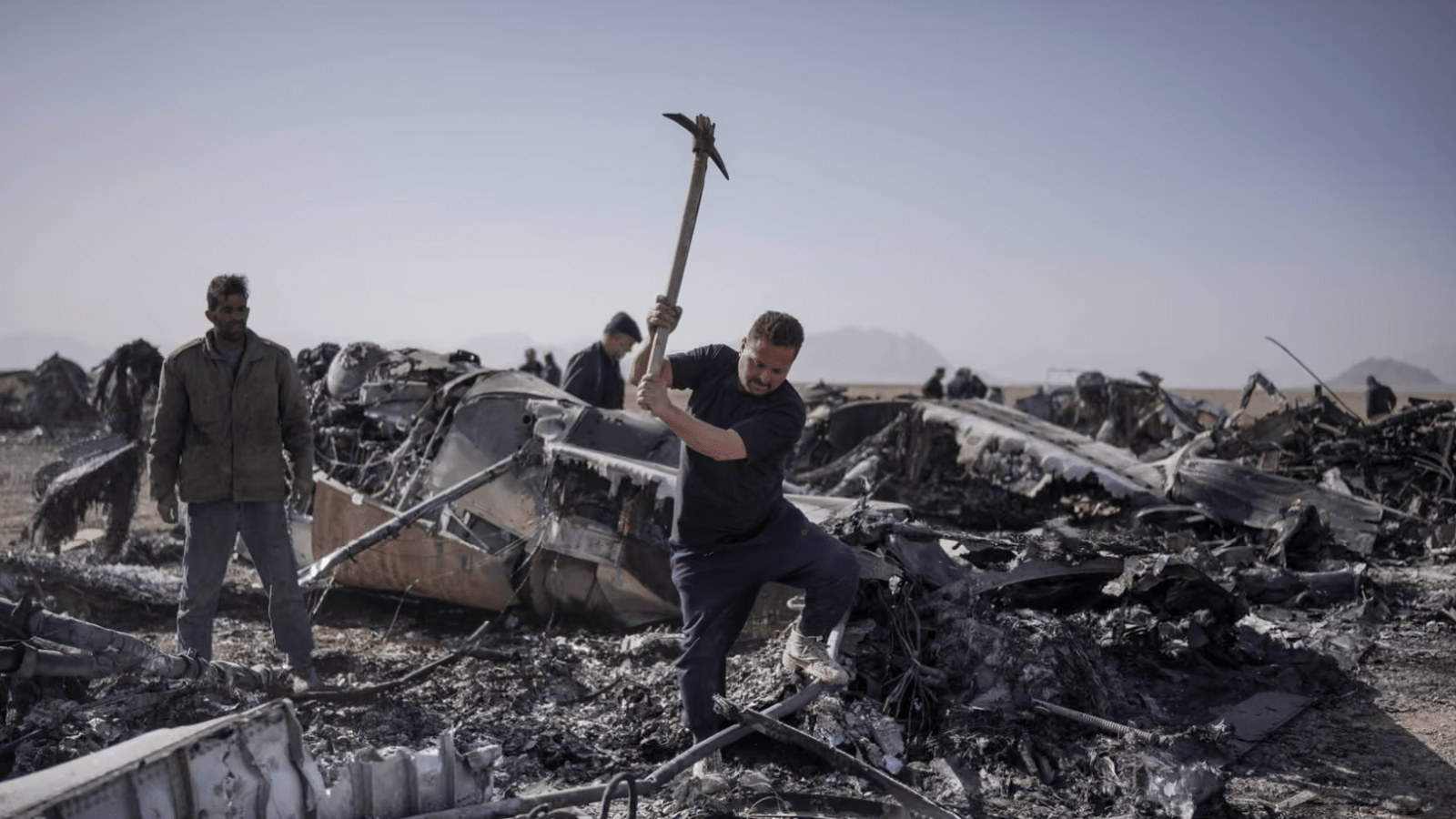
During extraction, both MC-130Js were mission-killed at the FARP. The official explanation was nose gear failure on the soft surface — but the physical evidence, bullet impacts, air burst damage, and side-by-side aircraft positioning, points to ground fire. All hardware was burned in place. The remaining force extracted by C-17s flown in from Kuwait or Saudi Arabia.
By the time Donald Trump posted “WE GOT HIM!” the following morning, his commanders had already briefed him on the outcome. The WSO was safe. But the cost was real. Multiple US aircraft had been destroyed during the extraction.

“The so-called US military rescue operation, planned as a deception and escape mission at an abandoned airport in southern Isfahan under the pretext of recovering the pilot of a downed aircraft, was completely foiled.” — Ebrahim Zolfaghari, Spokesman, Khatam Al-Anbiya Central Command
Two days later, Trump set a self-imposed deadline: Iran had until 8PM ET on 7 April to reopen the Strait. That third post ended with “God Bless the Great People of Iran!” Senate Minority Leader Chuck Schumer called him “an extremely sick person.” House Minority Leader Hakeem Jeffries called for an emergency congressional session. Democratic leaders said it “shocks the conscience.”
It didn’t reach 8PM. With 88 minutes to spare, a ceasefire between the US and Iran was struck, brokered by Pakistan PM Shehbaz Sharif.
Trump posted: “I agree to suspend the bombing and attack of Iran for a period of two weeks… This will be a double sided CEASEFIRE! The reason for doing so is that we have already met and exceeded all Military objectives.”
Oil prices dropped 16%. Global markets rallied. Trump claimed total military victory — without Iranian unconditional surrender, nuclear constraint, or regime change.
Islamabad and the Road Ahead
The Islamabad talks ended 12 April without agreement after 21 hours of negotiations. Iran’s foreign ministry said “diplomacy never ends,” framing future rounds as natural. State media blamed Washington’s “excessive demands.” Tehran has survived 40-plus days of airstrikes, kept the Strait partially closed, and emerged politically and militarily stronger than when the war began.
Vance’s “final and best offer” framing mirrors Trump’s “civilization dies tonight” post. The pattern throughout this war has been extreme threat, deadline, off-ramp accepted. The 7 April ceasefire followed exactly this arc. Whether it repeats before the 21 April expiry is the only question that matters now.
Four End States: How This Conflict Actually Ends
The situation is narrowing into four plausible end states.
One: the ceasefire holds and talks resume — the framework survives through mutual ambiguity, with Iran adjusting its nuclear language and/or the United States diluting its objectives.
Two: the ceasefire expires, but war does not — a frozen conflict takes hold, defined by controlled tension, partial Strait access, and sanctions remaining in place while both sides claim victory without resolving anything.
Three: war resumes — the US escalates under weaker leverage, relying on airpower with diminishing returns.
Four: an external broker intervenes — a face-saving formula emerges, but any formula will face harder limits on nuclear terms.
Before the war, Iran’s primary deterrent was nuclear ambiguity. Now it holds a second: the Strait of Hormuz. Nearly 25% of global seaborne oil trade and 20–30% of fertiliser exports move through this corridor — one of the most critical chokepoints in the global economy, and one Iran has now demonstrated it is willing and able to close. The consequences would fall hardest on Gulf states and their energy consumers across the world.
Analyst Disclaimer: This report is based on open-source intelligence, geolocated imagery, official statements, and analytical inference. It does not represent official government or military positions. Conclusions are probabilistic.