
200 nationalities. ~11.35 million population. ~88.5% expatriates. 68% South Asian. ~$2.5 trillion sovereign wealth.
The United Arab Emirates is, by measurable demographic data, one of the most expatriate-dominated economies on the planet. Approximately nine out of every ten people living in the UAE are expatriates. In Dubai, Emiratis are an estimated 10–15% minority in their own city. These are hard structural facts that define how the country works, who drives it day-to-day, and why it has proved remarkably resilient.
What separates the UAE from every other nation that relies on a foreign workforce is the depth and breadth of that integration. In Luxembourg, expatriates are overwhelmingly European and culturally adjacent. In Hong Kong, the foreign layer is a thin professional class sitting above a predominantly Chinese population. In Singapore, the national identity is clear, dominant, and actively reinforced through citizenship policy. In the UAE, approximately 200 nationalities coexist and compete — each building its own economic ecosystem within the larger one. The result is not a host country with a foreign workforce. It is something closer to a country built by its workforce.
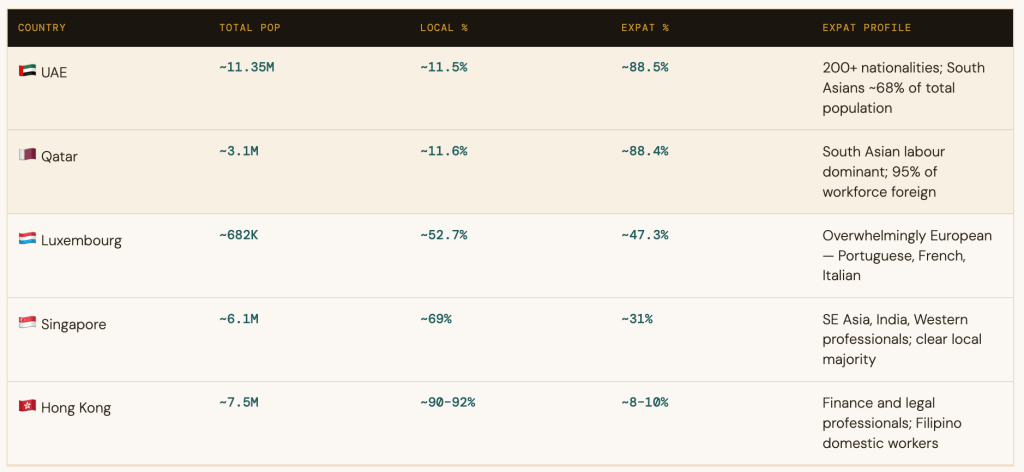
Only Qatar comes structurally close to the UAE’s demographic profile — but Qatar’s expat mix is more concentrated in South Asian workforce for a gas-export economy, with less diversity at the professional and entrepreneurial layers. The UAE’s model is broader and more genuinely global in its mix. Both countries, however, share a structural reality most comparable nations do not: the state is locally governed while the economy is overwhelmingly foreign-operated.
Expat Nationality Breakdown by City
City-level data confirms a consistent pattern across all seven emirates: South Asians form the structural majority everywhere. Dubai carries the widest global mix, reflecting its role as the UAE’s international business and lifestyle capital. Abu Dhabi has a stronger Arab professional and government layer, shaped by its role as the federal capital. Sharjah and Ajman are the primary South Asian family residential hubs — affordable, dense, and deeply connected to the subcontinent.

One Country, Seven Distinct Audiences
What makes the UAE uniquely compelling compared to other global city-states is internal variety at a scale no comparable destination offers. Seven emirates, seven distinct personalities, seven different audiences — all within a single day’s drive of each other.
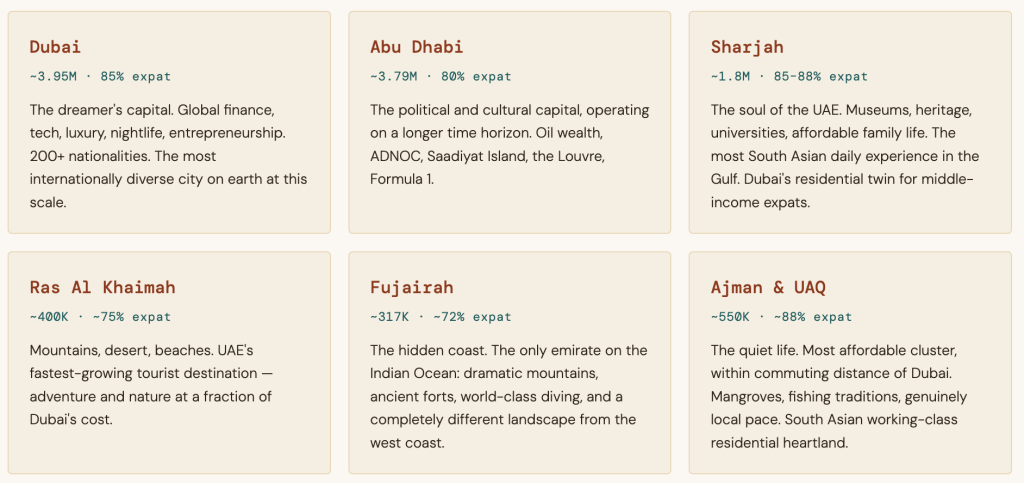
Dubai, Sharjah, and Ajman function as one interconnected economic belt — many residents live in Sharjah or Ajman purely for affordability while their professional and social lives play out in Dubai. It is effectively one mega-city operating across three price tiers, a structural reality almost never captured in external analysis of the UAE.
How the UAE’s $528 Billion Economy Is Actually Built
The most persistent myth about the UAE is that it runs on oil. In 1971, oil accounted for 90% of GDP. In Q1 2025, non-oil sectors reached a record 77.3% — the highest share in the country’s history. In Dubai specifically, oil contributes less than 1% of local GDP. The transformation is complete.
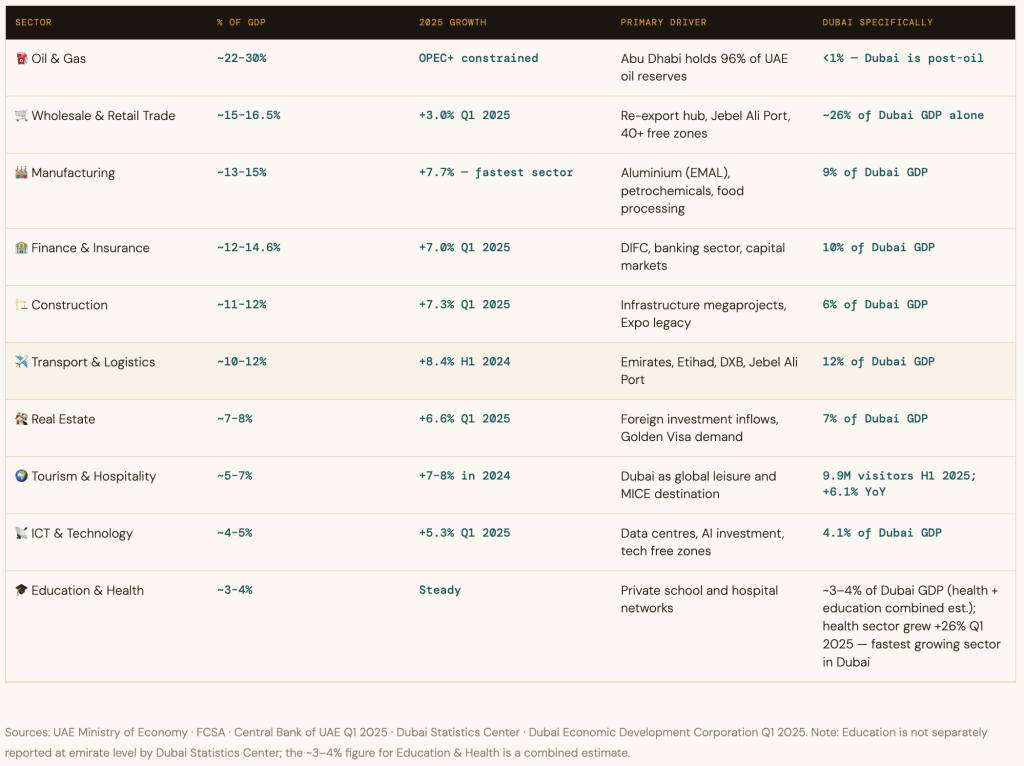
Three key readings from this data. First: trade — not oil — is the engine. Wholesale and retail is the single largest non-oil contributor, driven by Jebel Ali Port routing goods between Asia, Africa, Europe, and the Americas. Second: manufacturing is the surprise performer — growing 7.7% in Q1 2025, driven by aluminium and petrochemicals. Third: Dubai is post-oil by any measure. UAE GDP is projected to reach $685 billion by 2029 on non-oil growth alone. This is not diversification being attempted. It has already happened.
At the Centre of the World’s Flight Map
The UAE’s demographic and economic model did not emerge from thin air. It was made possible — and made inevitable — by geography.
Dubai sits at the precise geometric crossroads between East and West. Within an 8-hour flight radius lies roughly two-thirds of the world’s population. Within 14 hours, you can reach almost anywhere on earth.
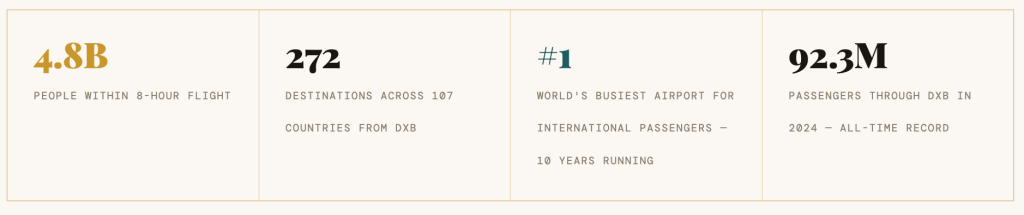
Dubai International Airport (DXB) is the world’s busiest airport for international passengers — a title it has held for a decade. In 2024 alone, 92.3 million passengers passed through its terminals, a new all-time record. It serves 272 destinations across 107 countries, with over 100 airlines operating around the clock. You can leave tonight and be in Tokyo, London, Lagos, Mumbai, Nairobi, or Singapore by morning. That is not a marketing claim — it is why global businesses, talent networks, and capital pools choose to base themselves here rather than in any regional competitor. Geography is the infrastructure that makes everything else possible.
Who Owns Dubai? — Property Buyers by Nationality
Dubai’s real estate market is the world’s most internationally diverse by buyer nationality. Full freehold ownership rights for all foreign nationals in designated zones have been in place since 2002, and buyers from over 150 countries have purchased property.

Three distinct stories. India’s 22% dominance reflects 50 years of South Asian wealth accumulation — buyers increasingly purchase as primary residences, not purely investment vehicles. Russia’s 9% surge post-2022 is geopolitical: Dubai as a financially neutral sanctuary with zero capital gains tax. Britain’s 2025 spike is fiscal: the UK abolition of the non-domicile tax regime triggered a high-net-worth relocation wave. Dubai’s property ownership map mirrors its demographic map with striking precision — the communities that built this city are now systematically buying pieces of it.
The Key Stabilising Layer of the UAE Economy
What makes the South Asian economic presence in the UAE significant is not just scale — it is vertical coverage. South Asians are arguably the only nationality group in the UAE that operates meaningfully across all three tiers of the economic pyramid simultaneously: blue-collar construction and logistics; retail, trade, and hospitality operations; and the white-collar professional and entrepreneurial layer — doctors, engineers, IT specialists, finance professionals, and founders.
Approximately 40% of Indians in the UAE are white-collar professionals or entrepreneurs. The community spans the full spectrum from daily-wage labourers to billionaires, with a substantial professional middle layer in between.
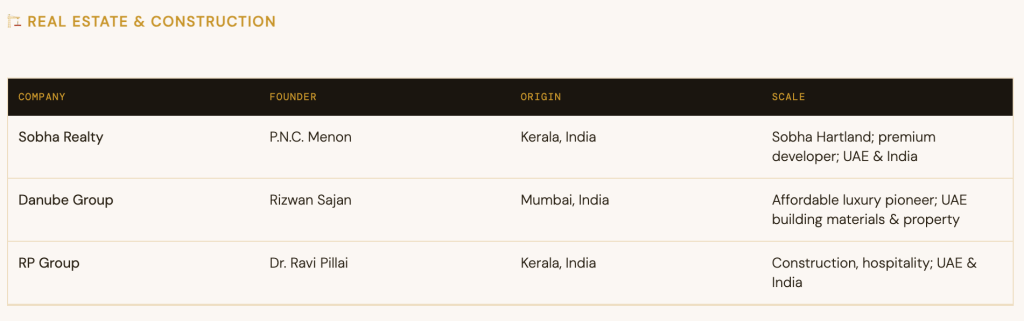
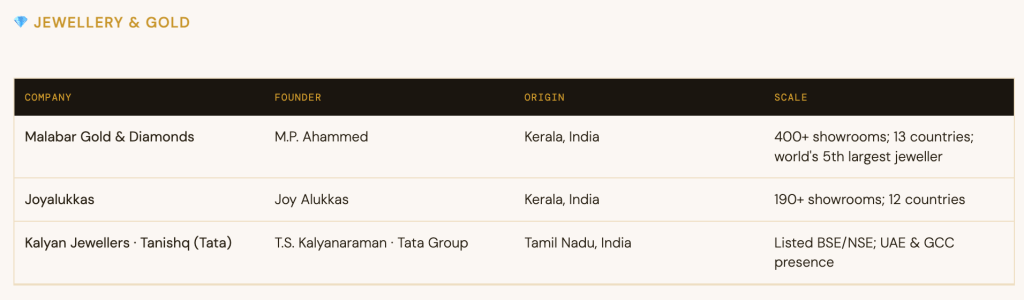
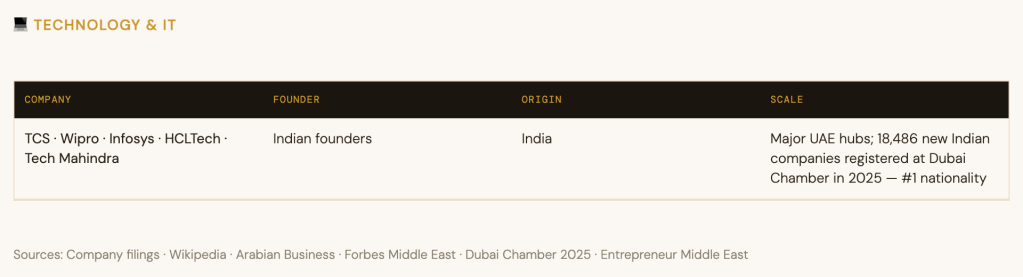
The South Asian Business Empire — Sector by Sector
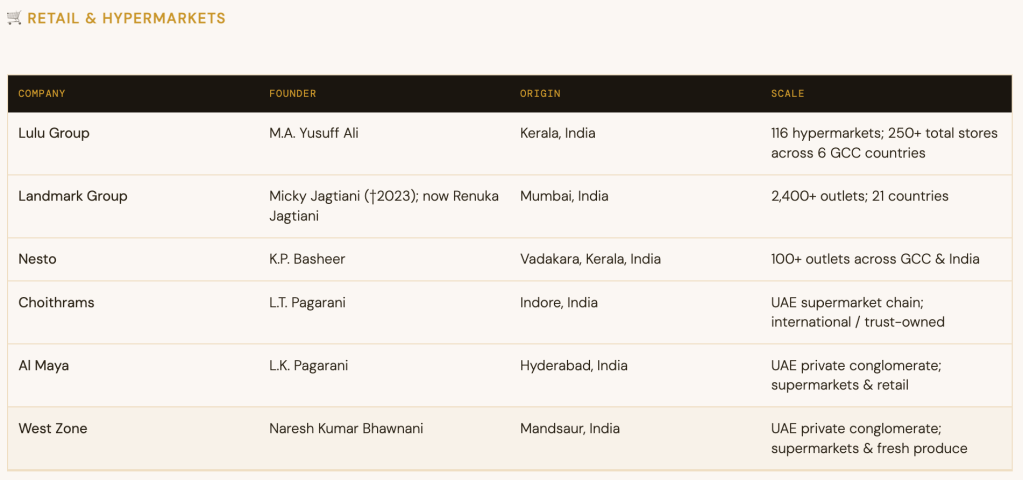
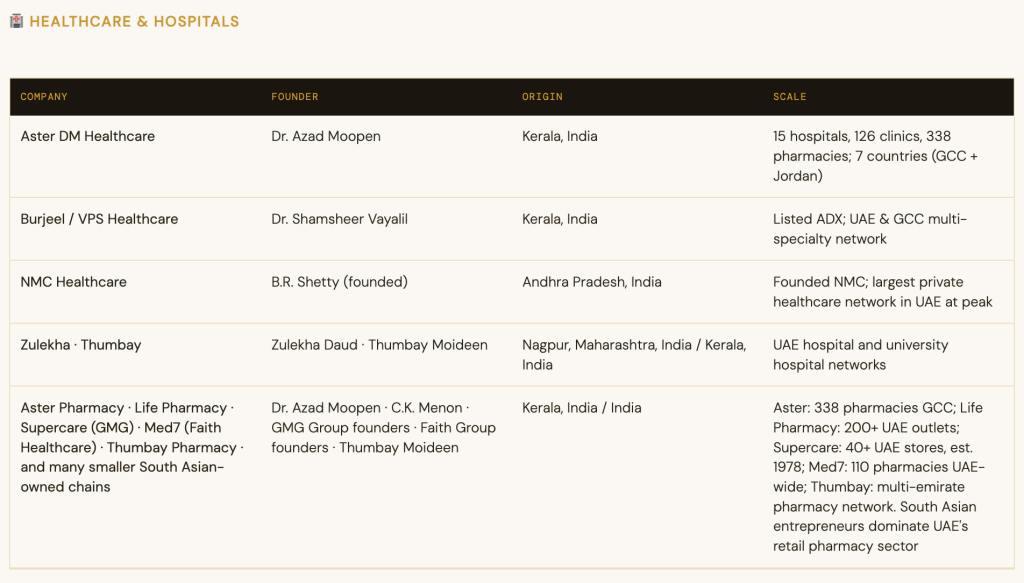
If you are a resident of the UAE, a significant portion of what you interact with in daily life — supermarkets, hospitals, schools, pharmacies, jewellery shops, and more — is owned or operated by South Asian, predominantly Indian, entrepreneurs. This is one of the most under-acknowledged structural realities of the UAE economy.

Billionaire Count — by Country of Origin
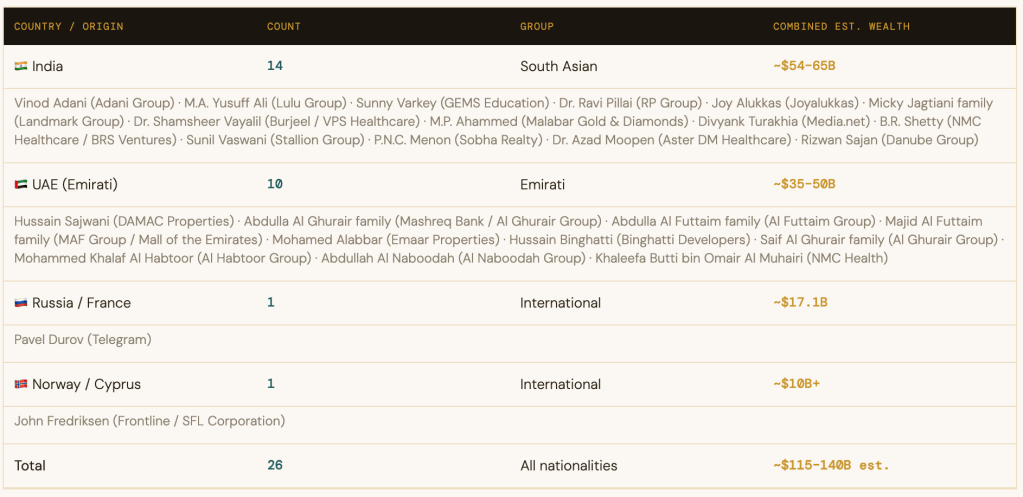
The UAE is home to an estimated 26 billionaires across all nationalities, with a combined estimated wealth of $115–140 billion. Indian-origin entrepreneurs dominate by count — reflecting five decades of wealth accumulation in trade, retail, healthcare, real estate, and education.
The Sovereign Balance Sheet
Most commentary on UAE resilience focuses on GDP growth rates, property transactions, and tourism arrivals. These are the visible layer. The deeper structural explanation lies in the sovereign balance sheet — a financial arsenal that makes the UAE one of the most shock-resistant nations on earth by any objective measure.
The UAE’s sovereign wealth infrastructure is among the most formidable concentrations of state capital anywhere in the world. ADIA alone — managing approximately $1.18 trillion — is larger than the entire UAE economy. These funds are globally diversified across equities, private equity, infrastructure, real estate, and alternatives, meaning a domestic economic shock does not directly impair them. When crisis hits locally, the funds are already deployed globally — and when the domestic recovery opportunity arrives, they can redeploy capital selectively.

Why the Floor Holds Every Time : The Two Pillars
Every crisis analysis focuses on what could leave: foreign capital, Western tourists, tech investment. What consistent analysis misses is what does not leave. The expatriate communities most deeply embedded in the UAE — particularly South Asian entrepreneurs, workers, and families who have built their lives, businesses, and futures here — are not a transient workforce on short-term contracts. They expand and contract in response to market conditions, but they do not disappear.
The standard narrative goes like this: the UAE holds enormous sovereign wealth, so when crisis hits, the state deploys capital, confidence is restored, and the economy recovers. This is true as far as it goes. What it omits is the prior question — capital deployed into what, exactly, and through whom?
Capital is potential energy. Labour is the mechanism that converts it into real economic output. A sovereign fund deploying $50 billion into a depopulated or economically inert economy produces nothing. The money has nowhere to land, no hands to circulate it, no businesses to absorb it, no households to spend it. The fund is not the engine. It is the fuel. The expatriate operating layer is the engine.